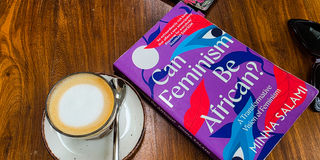
‘Can Feminism be African?’ By Minna Salami: It has always been

What you need to know:

  • Can Feminism be African? is divided into three parts: Africa, Feminism, and Being. Through each, the author invites us to interrogate, imagine, and reimagine the concepts that shape our understanding of ourselves and the world around us.

When I saw this book at a bookshop, my curiosity was piqued. I mean, in my mind, feminism has always been African. I have always believed that many of the choices I have today exist because feminism made them possible. But I was curious; I wanted answers to that question, and, most importantly, I wanted to understand what the answer meant in light of the book’s title, so I picked it up.

This is not a book you simply read. It pushes you to examine ideas you may never have questioned before, not only about feminism, but also about Africa, knowledge, identity, and whose ways of understanding the world have come to dominate our thinking. More than once, I stopped reading just to think.

Can Feminism be African? is divided into three parts: Africa, Feminism, and Being. Through each, the author invites us to interrogate, imagine, and reimagine the concepts that shape our understanding of ourselves and the world around us.

In the section on Africa, Salami asks who gets to define what it means to be African. She argues that even the way we narrate African history reflects whose voices have been given authority. We often divide it into pre-colonial, colonial, and post-colonial periods, unintentionally centring colonialism as the reference point for understanding Africa.

Reading this reminded me of Things Fall Apart by Chinua Achebe, another book that refuses to let colonialism become the beginning of Africa's story.

But Salami is not interested in rewriting history for history's sake. She argues that the stories we tell about Africa shape how we imagine everything else, including feminism, identity, and even what it means to exist.

She challenges the idea that knowledge is limited to what can be observed, measured, or proven. She does not reject science or empirical evidence, but argues that they cannot explain everything about what it means to be human. They leave little room for our emotions, spirituality, imagination, hopes, dreams, and lived experiences. Yet these shape how we understand ourselves and the world around us.

As she writes, "For Empirical Africa to 'develop', it needs Metaphysics Africa. It is the Metaphysics—and not science, economics, traditional history and the like—that we can ultimately transcend the limitations imposed not only on our material existence but also on factors that impose those conditions in the first place."

I found myself wondering how often we dismiss knowledge simply because it cannot be quantified or proven. Some of the deepest wounds people carry, such as grief, loneliness, shame, and hope, cannot be measured in data sets, yet they shape how people live and the choices they make. Over the years, I have come to understand myself through paying attention to what happens within me. Maybe that is why this part of the book resonated with me so deeply.

If Salami argues that Africa must reclaim the authority to define itself, then feminism cannot be an exception. She challenges the assumption that feminism is foreign to Africa. She argues that this belief is one reason feminism continues to face resistance across the continent, despite African women having long histories of resisting injustice before the term feminism entered the conversation.

She asks what feminism looks like when it grows from African histories, cultures, struggles, and ways of knowing rather than being measured against Western frameworks. She calls this Homegrown Feminism, "a sui generis movement born in the 1970s from the lived experiences and struggles of African women."

I found this idea refreshing because debates about feminism often become debates about whether it is "African enough." Salami shifts the conversation. Instead of asking whether African women fit existing definitions of feminism, she asks whether those definitions have ever made enough room for African women's experiences, including the ways they have long been marginalised within their own cultural, political, and economic contexts.

Perhaps that is true of more than feminism. We cannot keep borrowing other people's definitions of who we are and expect to know ourselves. Reading Salami reminded me that perhaps the people best placed to define our realities are those who live them.

I love that Salami doesn't attempt to answer the questions she asks in this book. She leaves the reader with them, trusting that the work of reflection belongs to each of us.

By the time I reached the final page, I realised this is a book about the joy of becoming. Of becoming a woman unapologetically. An African unapologetically. A feminist unapologetically. Ultimately, it is about insisting on women's full humanity. Women's thoughts, experiences, feelings, imagination, and hopes have always belonged in the story of what it means to be African.

Jane Shussa is a digital communication specialist with a love for books, coffee, nature, and travel. She can be reached at [email protected]