The life-changing school for Chamwino’s peripheral communities
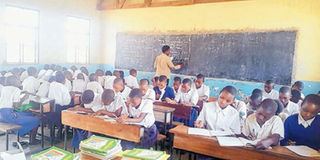
successStudents of various classes at Msanga B Primary School occupying one classroom while different lessons are ongoing. PHOTO I KHALIFA SAID
What you need to know:
Established in 2009 as a ‘satellite,’ Msanga B Primary School has transformed the lives of tens of hundreds of children from the communities that surround it
It had never crossed Mwalimu Iddi Mloba’s mind that somewhere in the capital of Tanzania, Dodoma, there exist people who are unable to conversely communicate in Kiswahili, the country’s national and official language.
But such is the situation he encountered after he was transferred from Msanga Primary School to assume a new position as a headmaster of Msanga B Primary School in 2010.
Over the years since Mwalimu Mloba started his tenure at the school, things started to improve. Literacy levels started showing signs of life, slowly the status of education started changing and the results couldn’t be more impressive. In fact, the improvement in literacy levels has become one of the several tremendous transformations that the communities surrounding the school have experienced, a direct attribution to the construction of the school there.
Located a few kilometers away from the newly-constructed Chamwino State House, Msanga B Primary School started as a satellite in 2009. At that time it was still an informal school intended to cater for educational needs of children in the surrounding communities.
It currently has a total of seven teaching staff, four male teachers and three female. A total of 401 students from Standard I to Standard VII, girls numbering 194 while boys are 217, access their education here.
Three villages of Msenje, Nati (the village where the school is situated), and Lusinde surround this school. Essentially, it was the children from these very communities who were the targets for its establishment.
Msenje village offers a great proportion of the students who join the school. In fact, in an 81-student Standard I, almost 60 of them come from the village.
The inception
The Msanga Ward within Chamwino District has had only one primary school since this country obtained its independence in 1961, the Msanga Primary School. This was a very challenging scenario for the Ward that has a total of 9663 people as per the 2012 national census.
Part of this challenge is the inaccessibility of the school by majority of children from Msanga’s peripheral villages. Students were subjected to a long distance walking to and from school.
The situation became even unbearable during the rainy season as rivers used to overflow and roads made unpassable. Though there is a bridge along one river that allows passage of children on their way to school, during heavy rains it also becomes useless as water often overwhelms it.
It was against this backdrop that the idea of establishing Msanga B School as a satellite came up, it was intended to help children from the affected communities have access to education.
Initially, the school was just an extension of the Msanga Primary School thus the name satellite. Developed in 2004 for an Oxfam-Novib project in South Kivu (DRC), the concept of satellite school seeks to provide an answer on the large capacity and effectiveness problems of primary education with an emphasis on remote areas.
Applying this experience, Action Aid Tanzania established the school by building two classrooms and equipped them with 28 desks, two tables and two chairs. Combined with the villagers’ commitment, the Johannesburg-based non-governmental organization also constructed a teacher’s house which gives shelter to the headmaster.
While Chamwino Municipal Council provided the school with Sh3 million and the District Executive Director bought 100 cement bags, Action Aid Tanzania provided it with Sh10 million for roofing.
Mr Elias Mtinda, Action Aid Tanzania’s Regional Manager for Dodoma and Singida regions, explains that their support was motivated by the villagers’ commitment to have the school near their homes for their children’s education.
“We thought it was important to help (the villagers) because their children were missing the studies during the rainy (season) which didn’t augur well with (the children’s) future.”
From an amateur to a professional
Before Mwalimu Mloba’s arrival here, the school was taken care of by an untrained teacher, Mr Samuel Seng’ana, who would later be replaced after it was found out the students needed a teacher who went through the teacher training courses.
In 2010, Mwalimu Mloba took the reign coming from the ‘mother school’ of Msanga Primary where he used to serve as an academic master.
He started alone only to be joined later by other teaching staffs currently constituting seven. He remembers there was a time he was alone at the centre but was later joined by a female staff, Ms Janet Balisidya.
“It was quite challenging,” shares Mloba, “(she) used to have health problems which made her randomly collapse. Being a man, attending and taking care of her was not an easy task.”
He asked for a replacement and was assigned another female colleague. Fortunately enough, this time the teacher, Hellen Nakomolwa, didn’t have any health complications.
All these years, however, the school has been operating informally as a satellite until 2013 when it was offered with full official registration. This enabled it to get a capitation fund of which it previously lacked.
Introduced in 2002 with the Primary Education Development Program (PEDP), the fund aimed to replace the revenue lost to schools because of the abolition of fees and to improve the quality of education by making real resources available at the school level.
Scoring with flying colours
This grant helped the school finance the purchase of textbooks and other teaching and learning materials, as well as to fund repairs, administration materials, and examination expenses. And it even boosted its performance in national examinations too.
In 2016, the school started offering its first Standard VII class of 29 students. Twenty-two of them scored well in the subsequent exams with seven failing. 2017, too, was not such a bad year for the school as its second Standard VII class of 25 students saw 15 of them scoring well in their exams.
These performances came amidst a myriad of challenges as students of various classes were mixed in one for there were only two classrooms (now two more class rooms have been added at the school compound.) For example, Standard III and IV used one class while Standard V, VI and VII used the other.
Standard I and II used to study under the baobab tree located in the school compound. But later, the school was able to convince the villagers to come together and contribute in the building of more school infrastructure, as a result two more classrooms were erected. (However, nursery children still study under the baobab tree.)
“It’s hectic,” the headmaster Mwalimu Mloba confesses. “We struggle with our meagre resources to make sure that our children acquire the required education.”
In the next part of this two-series story, Success will look at the major transformations that have been brought about by the school to its surrounding communities since its establishment. It will also detail the remaining challenges that restrain the school from realizing its full potential.