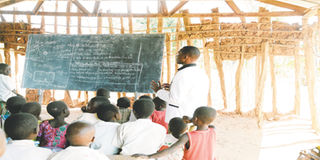
With the day-to-day worries of housing, transport, daily expenses and medical bills, it becomes difficult to devote oneself fully to teaching in rural parts of the country. PHOTO I FILE
What you need to know:
Like many schools in the rural areas, it is remote indeed as you spot snakes coming from the thick bushes surrounding grass-thatched houses.
Early this year, I visited Uhambingeto Secondary school in Kilolo District, located about 35 kilometres along Iringa –Dodoma highway.
Like many schools in the rural areas, it is remote indeed as you spot snakes coming from the thick bushes surrounding grass-thatched houses.
However, the aim of my visit was to have a clear picture of the working and living conditions of a teacher in the rural areas. *Wasoro Wakiso, is among the few teachers I met at the school. We could not reveal the real name since the teacher feared intimidation from the education officers.
Looking calm , Wakiso narrated her first experience when she started teaching at the school. By then, the school was still new and she was among the few female teachers to be posted in the region.
“When I was posted here I had my own expectations, I didn’t expect things to be like this.
I was uncomfortable in the first place, but I had to believe that things will change in the future but it was different as time went by things remain the same.” She explains adding that the school had few classes.
“I couldn’t see myself working under this condition therefore I asked to be transferred on the same year but I was not successful. There were no water, electricity,health facilities and even transport was an issue.” However she was not successful with her transfer request.
“I had to adjust then, to take things as they come through. It was a mission I had to fulfil because this was the kind of job I wanted to do in the first place despite all other short falls,” she narrated.
She says there is no hope for her as a teacher and even as a parent. “I have decided to let things remain as they are, I have even stopped asking for transfer because I know I will be wasting time and money to go to town for that,” she pointed out.
She lives in a rented house with no electricity and water.
“It is hard being away from your family but there is no other way round, I can’t let my family come and live here in a place where there is no electricity or proper and reliable health facilities,” she explains.
Today things have gotten a bit better, because before she used to go and fetch water from a nearby stream, but now her school has a borehole, now she can fetch water from the school.
She said some female teachers used to rent houses at the village but since it was not safe for them, they had to come and share dormitories with students.
“It is hard particularly for young female teachers who at times have to rent houses in the villages. Some men would disturb them so we thought the best way is for them to come and live in the dormitory .Their privacy is compromised but there is nothing else they can do because there are no houses for teachers,” she said
Although she is paid the same salary like teachers in urban centres, the working environment in rural is totally different.
“Sometimes you might find your salary end up in some expenses such as buying water or covering the transportation cost of going to town to follow up on a salary or to go for health facilities,” she explains.
However, despite all the hardship,she feels that her mission in life is being fulfilled because ever since its establishment 9 years ago, the school has opened doors to many young people from nearby villages, giving them a greater power that will enable them to make good choices over the kind of life they would wish to lead.
“Despite many of its shortfalls such scarcity of water, unavailability of teachers houses, the school has provided chances for many young girls to lead positive lives,” she states
Across the country, rural schools face some of the worst teacher shortages. But schools that are isolated, poor, and under performing struggle the most to hire teachers.
It is recognised that teachers are responsible for implementing educational goals and are key to creating knowledge based societies with values and ethics. However, they continue to face challenges brought about by staff shortages, poor training and low status.
Though Unesco while marking the World teachers Day yesterday stated that teachers and educators would be empowered, adequately recruited, well-trained, professionally qualified, motivated and supported within well-resourced, efficient and effectively governed systems, it is still a far cry from the reality on the ground.
According to UNESCO, Institute for Statistics estimates that to achieve the goal of universal primary education by 2020, countries will need to recruit a total of 12.6 million primary teachers.
World Teachers’ Day highlights the fact that teachers must be empowered as a critical step towards quality education and sustainable societies.