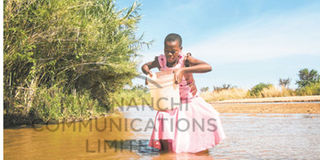
Eva Tolage fetches water from a muddy stream in Mlowa village in Iringa Region .PHOTO|KATARE MBASHIRU
What you need to know:
Eva Tolage, a Form One student at Mlowa Secondary School in Iringa Region is one of the young girls who sat down, thought critically and eventually wrote a letter to the US President Barack Obama.
If you thought a 15-year-old girl is not brave enough to write a serious letter to the president of a powerful nation in the world, then you are wrong.
Eva Tolage, a Form One student at Mlowa Secondary School in Iringa Region is one of the young girls who sat down, thought critically and eventually wrote a letter to the US President Barack Obama.
Her dream is to ensure that she passes all the examinations in both ordinary and advanced levels before pursuing a bachelor’s degree in Law.
You will be surprised if you ask her about the career she wants after graduating from campus. Eva says she wants to be a police officer, a job that many Tanzanians opt after failing to acquire other jobs of their choice.
“I want to become a traffic police officer and help majority innocent Tanzanians who have been dying in frequent road accidents due to drivers’ recklessness and corruption that is rampant within the police force,’’ says the soft spoken young girl.
Content of her letter:
In her letter to Mr Obama, the 15-year-old girl from rural Tanzania asked for his help to achieve her dream. The US President read out her letter on the final day of the United Nations Sustainable Development Summit in New York. The content of Eva’s letter was as follows:
“Dear President Obama
My name is Eva, Iam 15 years old from a rural village in Tanzania. 2015 is the year that we set the Sustainable Development Goals (SDGS) and I want to ask you if you will do something amazing for me and every girl in the world.
My dream is to be an educated girl because there is nothing we can enjoy without education. I want to see every single girl in the world being educated so that we can all achieve our big dreams.
This year, I finished my primary education. It’s not been easy—my parents have not always been able to pay for my uniform and text books but I did it and I’m really proud. I will do whatever it takes to graduate from any university so that I can achieve my dream to become a police woman and take care of my community.
It is difficult to study at night because we don’t have power and I can’t go through my notes in darkness. I spent almost the whole day at school without having any meals and it makes me lose my concentration. I am worried that it will affect my performance and I won’t be able to pass my exams—but my father is working extremely hard to find more resources for my studies and I won’t let him down.
I see many challenges in my village. My family lives off our farm and in the past three years we have not had enough crops due to changes in the local climate. We don’t have a water system in this community so we rely on rivers which go dry for many months, sometimes we cannot wash for four days at a time.
Some people are benefiting from the government power supply projects in remote areas but they are few and many lack power still.
There are also many challenges facing girls. We are not valued and our opinions are not heard. Many girls as young as 13 are being forced to marry and are not allowed to go to school. We are the ones to fetch water and collect firewood from the forest.
I would like to ask what you and the global leaders will do to ensure that every single girl in my village and Africa has better access to clean water, resources and education and to ensure the goals are delivered?
I was born in 2000, the same year the Millenium Development Goals (MDGs) were set.
This year, as I turn 15, you and other global leaders will agree a new plan for a better world. I know that my fellow girls and I in my village can play a great role in implementing the SDGs in this community once empowered and most importantly given the chance.
What will you commit in actually helping young people to lead development?”
Eva.
Eva is the second born in the family of seven children of Mr Shadrack Tolage and Huruma Ngewe. Her message to Mr Obama was heard by global leaders from 150 countries around the world who had gathered in New York between 25 and 27 September to formally adopt the new SDGs.
Her journey began at the beginning of this year when she became among the pupils aged 15 years old who convened together with 100 other young people, leaders of different Civil Societies and multinational organisations to have a dialogue with former Tanzania Vice President Mohammed Gharib Bilal.
The event provided a platform for young people to discuss their aspirations for the future they want and the key issues that they want their political leaders to act on. They also had a chance to act on the implementation of MDGs by asking the Vice President questions about their involvement in the consultation mechanisms towards creating a new post-2015 development framework.
Eva is part of the youth-led development agency, Restless Development which aims at putting young people at the forefront of change and development and ensures that their voices are heard. The lobby group reaches over 115,000 young people across 18 regions each year.
Restless Development in partnership with ONE, an international campaigning and advocacy organization, worked together to ensure that Eva’s message was read out by the President of the United States of America.
In regard to Eva’s message to the US president, Director of Children at the Ministry of Community Development, Gender and Children, Ms Margreth Sawe says the government has already prepared various policies to ensure that the rights of children are protected.
“The government has also prepared a programme that aims at weeding out early marriages and early pregnancies in collaboration with other stakeholders.
According to her, Gender-Based Violence (GBV) among young girls stood at 27.9 percent but the government was looking for a final and lasting solution against the vice.
Speaking last month at the International Day of Girl Child that was marked in Dar es Salaam at the national level, Dr Natalia Kanem, the United Nations Population Fund (UNFPA) country representative underscored the need to breach the gap between girls dropping out of schools because of different problems.
“We need to intensify the war against, violence, discrimination, exclusion and poverty although Tanzania is currently doing extremely well, she said.