During the campaigns one of the leading issues that featured on both camps was the quality of education that is offered to the Tanzanian child and its cost.
The General Election is over and the country is slowly bouncing back to normalcy once again.
During the campaigns one of the leading issues that featured on both camps was the quality of education that is offered to the Tanzanian child and its cost.
There were several promises that different camps traded but what they seemed to agree on was the fact that the sector needs to be modernised to meet the challenges of today’s world and the electorate is waiting for the delivery.
In a world that is fast changing, technology has become intertwined into almost all aspects of our lives.
It dictates how we socialise, connect, shop, play and maybe most importantly, how children learn and get taught.
To achieve this it calls for a massive investment by governments and the private sector in making technology attainable.
In a world which is full of all sorts of inequalities, it is easy for disadvantaged students in poorer districts to fall behind on newer technological trends resulting in disastrous consequences.
As agreed by most stakeholders, it has become increasingly important to get young people involved in technology at an early age.
Social media, as it has proved runs the world today, therefore today’s children are growing up in a world where social media, mobile technology and online communities are fundamental to the way that they communicate, learn and develop.
In recent years, the speed, flexibility and affordability of rapidly evolving technology has helped close the digital divide and enabled millions of young people in developing countries to join the digital world.
The integration of technology in classrooms is a monumental task which faces all sorts of problems including a huge disparity when it comes to technology access, whether due to socioeconomic factors, lack of resources, knowledge or budget.
Classroom memories recall images of dusty chalkboards, pencil sharpeners, stick on the teacher’s table and textbook covers made out of brown paper bags.
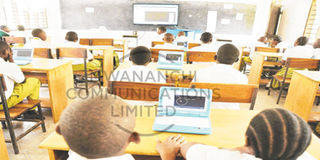
While such images are still the order of the day in Tanzanian classrooms around the country, some have been catapulted into the future with digital boards, lap tops and Chromebooks replacing textbooks.
Vodacom Tanzania, a mobile service provider in the country, recognises the importance of young Tanzanians being trained in modern technology trends.
“In Tanzania, many rural schools still struggle even to have access to electricity, not to mention being able to afford a computer,” says Renatus Rwehikiza the head of Vodacom Foundation.
He adds: Restricted access to technology by students leaves them lagging behind their peers in other countries when they apply for their future careers, which will most likely include some sort of technology.
According to Mr Rwehikiza not only does technology train youth for jobs in their future, but students enjoy learning more with a hands-on approach when they are able to use a computer, tablet, calculator or other devices.
“Modern technology is inherently attractive to young people and it increases excitement and interest in the classroom,” he says.
Every learner has unique qualities, this is why using technology can also appeal to different learning style, as not every student remembers facts best by hearing them from a teacher.
He says, “technology allows for an interactive learning environment where the students can take responsibility for their own learning.”
In ensuring that the Tanzanian youth have every academic advantage necessary to excel as productive citizens in a world run by technology, the Vodacom Foundation has come up with a plan.
Through the Smart School Programme, the company has donated various Information and Communications Technology (ICT) equipment to seven schools from both urban and rural areas of the country.
Some of the schools are Mtakuja and Kinyerezi secondary schools in Dar es Salaam.
During the 2014-2015 period the company donated 120 laptops, 40 desktops, five printers and four plasma screens with more than 8,500 learners expected to benefit from this programme.
This according to Rwehikiza is because they believe that technology brings young people in contact with a broader world opening access to education and training in a very cost-effective way.
“Technology has the potential to be a huge force for good for Tanzanian youth around the country and it is likely to play an increasingly important role in young people’s lives around the world,” he says.
He says that the foundation realises that when a school is able to have access to computers and other digital technology devices, not only are they teaching their students new skills and exposing them to the world out there, but they are also keeping up with their students who will inevitably be drawn to whatever is new and relevant.
But as these schools and youth enjoy the timely shot in the arm from Vodacom, there are some stakeholders in education who argue that technology alone will not change our global rankings in education.
“Technology by itself will almost never change education. The only way to change educational practices is to change the beliefs and values of teachers, administrators, parents and other educational stakeholders--and that’s a cultural issue, not a technological one ... It’s about processes and people rather than bits and bytes,” argues Johnson Massawe a head teacher in Dar es Salaam.
According to him introducing technology with all the advantages that it provides into a rigid environment is not going to suddenly open up a world of possibilities as intended by providers.
But even with his reservations he has a reason to believe that this is the way to go if the Tanzanian youth is to expand the realms of possibilities.
“When I imagine the classroom of the future, I imagine a place where teachers and technology are partners in fostering that creative, curious urge and helping harness students’ authentic motivations towards learning,” says Massawe.
Adding that with or without technology, that’s ultimately the goal of any classroom experience, and if technology can serve as the catalyst for getting to that place, we need to embrace it now.