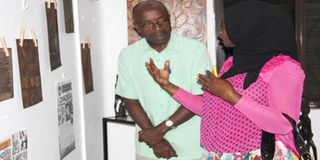
Henna artist Jamila Mataka (right), at the calligraphy exhibition at Vipaji Gallery
What you need to know:
The iconic building of Nyumba ya Sanaa for instance was the leading part and crafts house established in the early 1970s as an organisational trust providing employment for Tanzanians through the creation of Art form.
The visual artists of Tanzania had enjoyed a great support in the first two decades after independence. This golden period allowed artists to flourish knowing their skills and talents were encouraged and valued through a spirit of local and international humanity.
The iconic building of Nyumba ya Sanaa for instance was the leading part and crafts house established in the early 1970s as an organisational trust providing employment for Tanzanians through the creation of Art form.
It was an important independence heritage landmark which nurtured the first generation of modern Tanzanian artists. It also played an important part of the liberation heritage of Tanzania.
Unfortunately the iconic building was not to last because after 30 years and despite attempts to save the building, it was demolished in 2012.
Since then, many artists have lost a platform to develop their ideas, learn new technical skills, exhibit and sell to local and international buyers. Though there has been an existing number of art space opened to cover that gap, unfortunately some of these galleries have perished along the way.
However, that has seen efforts being made by individuals and organisations to creating a space for artists to showcase their work, this has been evident after American Maryknoll Sister Jean Pruitt who was then a principal founder of Nyumba ya Sanaa started a foundation called Vipaji Gallery.
Aiming at empowering artists through local held workshops so as to enable them to interact with local and international artists in the expression of creativity, the gallery has managed to open doors of opportunity to artists across the country.
Just last week, artists from Zanzibar had an opportunity to share their work of art in the first ever exhibition of the calligraphy prints where, among other paints, were several of the first calligraphies produced by the Henna artists.
Seven years ago, Vipaji Foundation ran a workshop together with Mawazo gallery introduced Henna painters to a new medium, acrylic painting and canvas. Today, these artists now established their own gallery in Zanzibar and their paintings are not only in the Bank of Tanzania Conference centre but they are now walled all over the world .
The leading expert on etching, Fransis Imanjama, who has been an instructor in numerous print workshops says having such exhibitions is crucial because of the platforms they allow for artists to showcase their work. Such shows also encourage artists to stretch their talents and show them there are interests in visual arts in the country.
“I met sister Jean in 1976 at Nyumba ya Sanaa. it was there where I learned how to etch and through that house I had a lot of opportunities to grow as an artist, that’s why whenever I see efforts like this to promote artists I appreciate it a lot,” says the expert.
He says the demolishing of Nyumba ya Sanaa was a blow to many artists who depended on it for recognition both within and outside the country .
“Unfortunately the number of artists grew but they had no particular place to exhibit their work, that’s when we saw the mushrooming of private art houses and galleries but few of them managed to survive,” says Fransis. “Having Vipaji Gallery is a stepping stone to where we want to go but I still think we need more galleries.”
According to him some galleries have failed to survive for long because owners don’t value them but focus on running them as businesses and that is why such buildings are demolished to pave the way for commercial buildings.
When sister Jean and Tanzania Cigarette company joined hands to support artists through Vipaji Foundation, according to Fransis there has been a spirit that has been awakened to recognise the work that has been done by other art centres such as Nafasi Art Space to support artists.
He urged individual and private sectors to give support to the industry by investing in art gallery because the more we have them the more chances artists will have to grow professionally. “We have five art Galleries in Dar es Salaam which we hope will motivate artists since they don’t have reliable places where they can meet a reason why they are not recognised compared musicians; I believe there are chances for us to grow and be well recognised.”