Tulia’s illustrious political journey

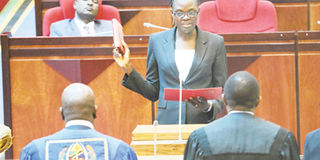
New Deputy Speaker of Parliament, Dr Tulia Ackson. PHOTO I FILE

What you need to know:

A number of surprising moves have led up to Dr Ackson’s political rise. But let us start from the beginning. On September 9th this year, former President Jakaya Kikwete appointed Dr Ackson 16th deputy Attorney General (AG) – a position where she was second most high-ranking government legal officer behind the Attorney General George Masaju.
Dr Tulia Ackson’s political career so far has been a short but an intensive one, causing many debates within Tanzanian politics. The former Deputy Attorney General is the Deputy Speaker – the first one who is not an elected MP.

A number of surprising moves have led up to Dr Ackson’s political rise. But let us start from the beginning. On September 9th this year, former President Jakaya Kikwete appointed Dr Ackson 16th deputy Attorney General (AG) – a position where she was second most high-ranking government legal officer behind the Attorney General George Masaju.
Dr Ackson has extensive education in law and 10 years’ work experience in the legal field. She studied law at the University of Dar es Salaam, obtaining her Master’s Degree in 2004. She was admitted at the University of Cape Town in 2005 for her doctoral studies and obtained a doctorate in Philosophy in 2007.

Dr Ackson is an expert in a number of fields, such as social security law, labour law, wildlife management laws, trusts, probate and administration of estates law, project financing and mining law. Moreover, Dr Ackson is a Member of the Tanganyika Law Society, East African Law Society, and Southern African Development Law Society. She regularly writes articles and talks about employment law matters and her practice covers all aspects of Tanzania’s employment law – from hiring, to firing, to handling disputes between employers and employees.

As deputy AG, she represented the government in various legal issues. Dr Ackson led a team of state attorneys in a constitutional case over the interpretation of the 200-metre distance from polling stations.

Her time as a deputy AG however, was but a short one: Dr.Ackson served for only two months. Last Friday she surprised Tanzanian politics in picking nomination forms seeking to be nominated by Chama Cha Mapinduzi (CCM) as candidate for the post of Speaker of the National Assembly. From there on, events unfolded in quick succession. Only two days later she was one of three CCM members shortlisted for the speaker position, next to Job Ndugai and Abdulla Mwinyi.

Legal controversy

The legality of Dr Ackson’s sudden plunge into politics by the candidature has been highly contested: According to Section F20 (2) (e) of the Public Service Standing Orders, state attorneys are considered public servants, and as such not allowed to participate in politics.

Her decision to contest the speaker’s position has thus been highly debated. A harsh critic of this move has been Prof Kitila Mkumbo, political commentator and psychology don. According to what he published via Twitter, Dr Ackson got away with her move because of her party membership: “Should an opposition member try the same move they would face problems. It (CCM) is called state-party!”

Prof Mohamed Bakari of the Political Science Department at the University of Dar es Salaam (UDSM) however, has taken up a different line of argument. According to him, Dr Ackson was right to contest for the post, as the major law dispenses a civic right to every Tanzanian who qualifies to enter the race – regardless of his or her occupation. “Therefore, one is not barred from contesting the post simply because he or she serves as Attorney General and he might not come from the ruling party.” Nevertheless, Bakari conceded that people pointed to sensitive posts such as deputy AG are expected to operate fairly without showing any political bias.

Only a short time later, however, Dr Ackson’s political position changed yet again. Whilst the discussion about her sudden plunge into politics was still raging, newly-elected President Dr John Magufuli appointed her as a special seat MP. Under Tanzanian law, the President has ten special seats reserved for him, the first of which he gave to the former deputy Attorney General. Dr Ackson took the oath as member of Parliament on Tuesday.

Within hours of her appointment, Dr Ackson made yet another surprising move by dropping from the speaker’s race. Not only her, but Mr Mwinyi as well withdrew his application. The remaining CCM MP Ndugai thus had an easy task as candidate for the post. He was elected to the post following an in-House ballot involving all MPs present in which he gained 254 votes out of the 365 cast.

Mr Goodluck ole Medeye of CHADEMA, who was his closest challenger, managed 109 votes. Other candidates were Tanzania Labour Party’s (TLP) Mr Richard Lyimo, Democratic Party (DP) Mr Robert Tasmini, Chama Cha Umma (Chaumma) and Mr Hashim Rungwe.

This election was still not an end to Dr Ackson’s political manoeuvres. Only hours later, she picked yet other forms – this time seeking the post of deputy speaker.

On Tuesday night, finally, CCM endorsed the former Deputy Attorney General to contest the deputy speaker’s post. The party confirmed the endorsement through its Twitter account. Chama Cha Mapinduzi accounts for 252 MPs out of 394 members of the House. Ackson’s election as deputy speaker is thus all but a given, as the ruling party has majority in the House.

According to Ms Jenista Mhagama, chairperson for CCM legislators, the office received four CCM applications. Besides Dr Ackson, the aspirants were Mr Mussa Azzan (Ilala), Ms Mariam Kisangi (Special Seats), Mr Sadifa Juma Khamis (Donge) and Ms Bahati Ali Hemed. The opposition has presented Ms Magdalena Sakaya who is contesting the post through CUF, backed by the opposition coalition, Ukawa.

The ruling party’s steering committee was to meet on Tuesday evening to choose three names, among which one person would be selected and be presented to the office of the Clerk of the National Assembly.

However, the four other CCM candidates that had picked up the forms for deputy speaker reportedly stepped down.

Ms Mhagama defended Dr Ackson’s endorsement. She said all CCM MPs had the right to pick up application forms and that the ongoing rumours that some MPs were asked to pull out of the race were not true.

Prof Abdul Sherrif, a prominent lawyer in Zanzibar, said that the kind of political manoeuvres such as Dr Ackson has shown are not first-time occurrences in Tanzanian politics.

“Similar situation occurred when the former Chief Justice Augustino Rmadhani picked presidential nomination forms on CCM ticket. His move made many people question the independence of the judiciary of the country.”

According to him the events show that appointments to many sensitive public offices base on safeguarding the interests of the ruling CCM.

Dr Ackson is the first deputy speaker who is not an elected MP, to the dismay of many members of the opposition. But whether Dr Ackson will overcome the political pressure building against her as she executes her duties remains to be seen.