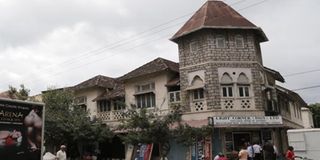
A twentieth-century building, part of a German colonial group of buildings at the corner of Samora Avenue and Bridge Street moments before it was razed to the ground in August, this year. PHOTO | FILE
What you need to know:
According to the New York-based organisation, the old city centre is characterised by a thriving street life and attracts artists from all over the world for its art and music events.
Dar es Salaam. Tanzania’s leading commercial city has, for the first time, been said to consist of some endangered cultural heritage sites, according to the 2014-2015 list of World Monuments Fund Watch.
According to the New York-based organisation, the old city centre is characterised by a thriving street life and attracts artists from all over the world for its art and music events.
However, the body says rapid urban development since the 1990s has hastened the demolition of Dar es Salaam’s most significant monuments and historic structures.
The development has come on the backdrop of a demolition spree of historical and cultural buildings and monuments within the city centre following a decision by the government, six years ago, to revoke the Antiquities Declaration of Conservation Areas.
One of the key structures that have been razed to the ground is the MC George Building located at the junction of Samora Avenue and Mkwepu Street which was demolished in 2008. The building was put up in 1901, and originally housed a police officers’ mess during German colonial rule.
It later served as a head office for a German pharmaceutical company before housing the legendary Salamander Restaurant.
In August this year, five other buildings owned by the National Housing Corporation (NHC) located along Samora Avenue, Mkwepu, Mansfield and Bridge streets were demolished to pave the way for high-rise structures.
Late August the Chief Secretary told The Citizen that the revocation was meant to allow the demolition of buildings that were of no historical value. He said buildings such as the one housing the World Health Organisation (WHO) Tanzania office, which was initially the first headquarters of the Ministry of Health, would not be demolished because of its historical value.
In every two years since 1996, the World Monuments Watch issues a list and calls for action to protect cultural heritage around the globe, particularly those at risk from the forces of nature and the impact of social, political, and economic changes.
The 2014-15 list mentioned 67 sites from 41 countries including four in Zanzibar, which included the Christ Church Cathedral and the former Slave Market Site, Zanzibar House of Wonders and Palace Museum.
House of Wonders, located in Stone Town and built by Sultan Barghash in 1883, suffered partial collapse due to old age in 2012. However, it has since been restored and opened for tourists.
Historic sites of Kilwa were the first in Tanzania to be documented in the list back in 1996 and again in 2008. Old Bagamoyo town was listed in 2002 and in 2010 Pangani historic town.