As Pakistan pursues a ‘Hard State’, regional grievances persist
By Fatima El Hashimi
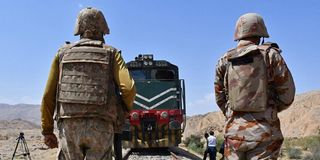
Pakistan's Army Chief, Field Marshal Asim Munir, has given the country's ruling establishment a new political vocabulary: the "hard state." In official language, it means discipline, national security, and institutional resolve. On the ground, in Pakistan's peripheries, it is increasingly understood as something harsher: centralized coercion, military-first governance and the treatment of dissent as a security threat.
Munir's rise has been unusually rapid and politically loaded. Appointed Army Chief in November 2022, he was elevated to Field Marshal in May 2025 after the India-Pakistan conflict, becoming the first Pakistani general in almost 60 years to receive the rank. Asim Munir's tenure was extended from the usual three years to five years through a parliamentary amendment passed in November 2024. Months before his promotion, at a March 2025 meeting of the Parliamentary Committee on National Security, he argued that Pakistan needed to move away from the habits of a "soft state" and become a "hard state" in dealing with threats.
That phrase now captures the mood of the federation. Across Pakistan-administered Kashmir, Balochistan, Khyber Pakhtunkhwa and Sindh, people are not merely complaining about poverty or poor services. They are questioning the political compact itself. Their grievance is that Pakistan's security establishment extracts resources, polices identity, criminalizes protest, and then presents the resulting unrest as proof that more force is needed.
Pakistan-administered Kashmir: Rights demands met with bans, bounties and bullets
Pakistan's contradiction is sharpest in Kashmir. Internationally, Islamabad presents itself as the defender of Kashmiri rights. In Pakistan-administered Kashmir, however, the security establishment has moved aggressively against local mobilization, treating a civil rights movement as a security threat rather than a political warning.
The Jammu Kashmir Joint Awami Action Committee (JKJAAC) emerged from ordinary grievances: electricity prices, wheat subsidies, governance failures, elite privileges and political representation. It is a civil platform made up of traders, transporters, lawyers, students and local rights groups. According to Associated Press reporting, the movement had a 38-point charter of demands, including subsidized wheat and electricity; authorities claimed 36 demands were accepted after earlier negotiations, while two remained unresolved. One of the central unresolved issues is the demand to abolish 12 assembly seats reserved for Kashmiri refugees living outside the region.
That dispute has now turned into a full-blown confrontation. The current unrest has pushed Muzaffarabad, Rawalakot, and other parts of the region into strikes, clashes, barricades, arrests, and heavy security deployments. Rawalakot became the flashpoint after deadly clashes; Reuters reported at least 11 people killed, while AP separately reported seven deaths linked to the Rawalakot violence. Some media reports placed the toll as high as 27 killed and over 200 wounded.
The response has been severe. The JKJAAC was banned on June 5 under anti-terror provisions, its leaders were targeted, sedition cases were ordered against prominent figures, internet and mobile signals were suspended, and Reuters reported a 10-million-rupee bounty for the arrest of four key JKJAAC leaders. Authorities also advised outsiders and tourists to leave the region, while federal paramilitary forces were deployed. In effect, the region was politically sealed at the very moment people were trying to mobilize.
The language used against JKJAAC follows the familiar script of Pakistan's security establishment: first delegitimize the grievance, then criminalize the protester, then justify force as law and order. A movement demanding cheaper electricity, wheat relief, local rights and political representation is now being pushed into the frame of sedition, terrorism and anti-national activity. This is how the hard state manufactures its own justification: It turns public anger into a security file.
The recent criticism from international observers and human rights organizations has made the crackdown harder to hide. Amnesty International said the "violent and sweeping crackdown" in Pakistan-administered Jammu and Kashmir included an internet shutdown, mass arbitrary arrests and the deadly use of force. It called the "terrorism" designation of JKJAAC a dangerous escalation and said branding a grassroots organization as terrorist while cutting the region off from the outside world raised serious concerns about the authorities' conduct and disregard for human rights.
Amnesty also noted that this is not an isolated episode. During the May 2024 Kashmir Long March by JKJAAC, three protesters and one police officer were killed. In October 2025, at least nine people were killed, including six protesters and three police officers, with hundreds more injured during protests in the region. The June 2026 unrest, therefore, is part of a repeated pattern: economic grievance, public mobilization, security crackdown, deaths, arrests and deeper alienation.
This is where Pakistan's Kashmir narrative begins to collapse under its own weight. A state that speaks of self-determination abroad cannot credibly criminalize local rights movements under its own control.
Balochistan: Where silence has become policy
Balochistan is Pakistan's largest province by landmass and among its richest in natural resources. Yet it remains one of the most deprived regions in the country. Its gas, minerals and coastline have long served federal and strategic priorities, while many local communities continue to live with broken infrastructure, weak services and a deep sense of political exclusion.
The arrest of Dr. Mahrang Baloch in March 2025 became a defining moment. She was not leading an armed movement. She had emerged as one of the most visible voices against disappearances and extrajudicial violence. Amnesty International reported that during a BYC protest on March 21, 2025 three protesters were killed through unlawful use of force according to local activists, mobile signals were shut down, and Mahrang Baloch was detained the next day along with 17 other protesters. It also noted that terrorism charges were brought against her, while other activists were detained in Karachi after protesting against the crackdown.
This is the central contradiction of Pakistan's Balochistan policy. The security establishment claims it is fighting militancy, yet its broad-brush approach often pushes peaceful political space into a corner. When families asking for the whereabouts of their sons are met with arrests, mobile shutdowns, terrorism charges and sedition narratives, the state loses moral ground even before the next security operation begins.
Khyber Pakhtunkhwa: A province treated as a battlefield
Khyber Pakhtunkhwa and the former tribal areas have lived through two decades of war, displacement, drone strikes, militant violence and military operations. Pashtun communities have paid a heavy price for Pakistan's security choices, first during the Afghan jihad, later during the War on Terror, and now amid the resurgence of the Tehreek-e-Taliban Pakistan.
Manzoor Pashteen, the founder of the Pashtun Tahafuz Movement (PTM), became the most visible face of this anger. Reuters reported that he was arrested in Peshawar in January 2020 on charges including sedition. His detention became symbolic of Pakistan's treatment of Pashtun dissent: a peaceful rights movement was not answered with accountability, but with police cases, loyalty tests, and accusations of foreign influence.
The ban on the PTM under terrorism laws further exposed the logic of the "hard state." Amnesty International said that on October 6, 2024, PTM was placed on the list of proscribed organizations under Pakistan's Anti-Terrorism Act, even though it described the movement as a grassroots platform peacefully advocating for Pashtun rights.
In Khyber Pakhtunkhwa, the security establishment's failures are often repackaged as the people's problem. Communities that suffered militancy, displacement and military operations are then asked to prove their loyalty when they demand accountability. This is a damaging cycle: the state makes security decisions, local people absorb the cost, and those who question the cost are branded suspect.
The Hard State's weakness
The hard-state doctrine may give Pakistan's security establishment the illusion of command, but even on its own terms, it is failing. A doctrine sold as discipline and security should be judged by whether it delivers stability. By the military's own 2025 figures, Pakistan carried out more than 75,000 counterterrorism operations and killed 2,597 militants, yet 1,235 civilians and security personnel also died. Pakistan Institute for Conflict and Security Studies (PICSS) data was even harsher: combat-related deaths rose 74 percent in 2025 to 3,413, up from 1,950 in 2024, including 667 security personnel and 580 civilians.
This is the contradiction Rawalpindi cannot hide. More operations have not produced more safety. More military control has not produced more political trust. Across Pakistan- administered Kashmir, Balochistan, Khyber Pakhtunkhwa and Sindh, the same playbook repeats: ban movements, arrest leaders, suspend communications, deploy force, blame foreign hands and call dissent anti-national. The result is not national integration, but deeper alienation.
That is the hard state's real weakness. It can occupy space, silence streets and manufacture temporary order, but it cannot create legitimacy through fear. If the security establishment cannot protect civilians, reduce casualties, resolve grievances or win trust, then the hard state is not a doctrine of strength. It is state failure dressed as discipline.
Fatima El Hashimi is a Moroccan researcher and journalist.