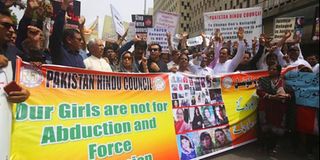
On May 12, 2026, Nisha Bibi, a 14‑year‑old Christian girl disappeared once again exposing the brutal machinery of forced conversion and coerced marriage in Pakistan. Nisha, a domestic helper from Gulbahar Colony, was taken by a married Muslim man who exploited her medical and mental vulnerabilities, forcibly converted her to Islam, and married her. Her father, Abbas Masih, a daily wage labourer, was stunned when police produced documents claiming she had converted months earlier and married of her own free will.
“We were shocked to see an alleged conversion certificate and marriage documents presented as proof,” he said, denouncing them as fabrications designed to shield the perpetrator from prosecution.
A statement submitted before a magistrate even alleged she was 18, seeking protection from her family. In reality, religion was being weaponised to evade accountability, and a vulnerable child was being erased.
Forced conversions and coerced marriages of minority women and girls in Pakistan have become one of the most disturbing intersections of gender‑based violence and religious discrimination. The victims are overwhelmingly minors between 12 and 17 years old abducted, threatened, and forced into marriages that are later legitimised through fabricated conversion certificates. In Pakistan today, being born female and non‑Muslim often means being stripped of autonomy, identity, and legal protection.
The case of Jia Liaqat, a 16‑year‑old Christian girl from Punjab’s Vehari District, illustrates the scale of the crisis. On April 3, 2026, Jia was abducted while her parents worked in the fields. Weeks later, her father received a WhatsApp call from a man in Dubai warning him against pursuing the case. Police failed to act, and Jia was allegedly married online to a Muslim man in the UAE. The case reflects a familiar pattern: cross‑border manipulation, local complicity, and police inaction.
In July 2025, Shahneela, a 15‑year‑old Hindu student in Badin district, was abducted at gunpoint by armed men and transported to Karachi. There, she was confined in a religious institution and forced to record videos “confirming” her conversion. Her family was powerless against a network of abductors and clerics who legitimised the coercion. Just weeks earlier, in Shahdadpur, four Hindu siblings- Jiya, Diya, Disha, and Ganesh Kumar were abducted. Within 48 hours, videos circulated online showing them reciting the Kalma, their names changed, their identities erased. Their mother’s anguished cry, “I had three daughters. He took all of them. And my only son” captured the devastation inflicted on minority families.
These cases reveal a deliberate pattern: abduction, coercion, fabricated documentation, and judicial validation. Religious conversion is exploited as a cover for sexual violence, while police and courts colludewhether through negligence or complicity to shield perpetrators. The trafficking pipeline is clear: abducted girls are raped, declared “converted,” and married to their captors, cementing their erasure from their communities.
Pakistan ranks eighth on Open Doors’ 2026 World Watch List of countries where Christians face the most severe persecution. UN experts have described forced conversions as “systemic,” urging Pakistan to raise the marriage age to 18, criminalise coercion, and provide shelters and psychosocial support. Yet legislative reform remains stalled, blocked by clerical opposition and political expediency.
The sheer scale of recent cases has reverberated into the deliberations of the Peoples Commission for Minorities Rights (PCMR) on May 27. The commission demanded urgent enactment of laws against forced conversions and pressed for the operationalisation of the National Commission for Minorities Rights Act 2025, which remains dormant five months after passage. “Legislation alone is not enough,” Ms Atif warned, insisting that the commission must begin functioning transparently and without delay. Dr Riaz Sheikh was unequivocal: “Forced conversions remain one of the gravest violations of human rights and religious freedom in Pakistan. The government has a constitutional responsibility to protect every citizen’s right to their faith.”
Pakistan today faces what rights advocates have called a ‘paedophilic emergency’ a crisis that specifically targets underage Hindu and Christian girls. These children are kidnapped, drugged, threatened, and coerced into marriages that courts later defend as “love marriages.” Their vulnerability is compounded by gender, caste, and religious identity, while the state’s laws and institutions have shifted from neutrality to outright discrimination. What should be treated as heinous crimes rape, abduction, trafficking are instead legitimised through the veneer of religious conversion.
The case of 12‑year‑old Zarviya in Rawalpindi (2022) remains emblematic. Lured under the pretext of buying a Mother’s Day gift, she was kidnapped, drugged, married to a 35‑year‑old man, and forcibly converted to Islam. Her abductors threatened to kill her brothers if she resisted.
The machinery operates with chilling efficiency. A minor girl, often from a poor village or peri‑urban settlement is abducted by landlords or local power brokers. Rape follows, intended to shame her and her family. A marriage is then arranged, legitimised through conversion to Islam. Provincial laws prohibiting marriage under 16 are bypassed through forged documents and manipulated birth records. Courts routinely accept these fabrications, treating the matter as a religious issue rather than a criminal one. Lawyers for abductors argue the girls “voluntarily” converted, and judges bow to pressure from Islamist groups. In Zarviya’s case, the Lahore High Court dismissed proceedings in 90 seconds, declaring her marriage consensual.
Most cases never reach court. Families fear retaliation, and those who do report face backlash from right‑wing groups claiming that girls “escape poverty” by marrying older Muslim men. In reality, abduction and conversion serve to erase religious identity and assert dominance over entire communities. The People’s Commission for Minorities Rights has documented how many girls are trafficked into sex work, violating constitutional protections against slavery and forced labour. This climate of fear has compelled many minority families to flee Pakistan, as rights advocates warn that the state’s failure violates both constitutional guarantees and international obligations under the ICCPR and EU’s GSP+ framework.
Entrenched impunity is reinforced by judicial failures and political cowardice. In October 2021, a federal parliamentary committee rejected a law against forced conversions under pressure from Islamist groups. Sindh’s attempts to outlaw conversions under 18, were blocked after religious parties threatened mass protests. Figures like Pir Mian Abdul Khaliq (Mian Mithu), central to many conversion cases, led campaigns claiming girls converted willingly.
The contradictions in Pakistan’s legal framework deepen the crisis. While the law defines a child as anyone under 18, the Child Marriage Restraint Act (1929) and Muslim Family Laws Ordinance (1961) set the minimum marriage age for girls at 16 everywhere except Sindh. This loophole enables abductors to exploit minors with impunity. The Sindh Human Rights Commission in 2025 highlighted a rise in child marriages and forced conversions among Hindu minorities, underscoring how weak enforcement perpetuates abuse.
Courts have repeatedly validated underage marriages: in 2020, the Sindh High Court ruled the marriage of minor Huma Younus permissible because she had reached puberty. In 2012, the Supreme Court ignored the age of Rinkle Kumari, abducted at 17, and allowed her abductors to “take her home,” despite her pleas of coercion. In 2019, teenage Hindu sisters Reena and Raveena Lal disappeared from Sindh, later reappearing in videos with Muslim men claiming marriage. Their family insisted they were abducted, sparking protests by nearly 2,000 Hindus, yet the Islamabad High Court ruled the conversion “voluntary.”
Most recently, on May 6, 2026, Pakistan’s Federal Constitutional Court questioned the reliability of NADRA birth records in a case involving a 15‑year‑old Christian girl allegedly forced to convert. Judges remarked that such documents could be manipulated, undermining the very evidence meant to protect minors. In February 2026, the same court upheld the marriage of Maria Shahbaz, a 13‑year‑old Christian girl, to a 30‑year‑old Muslim man, dismissing official records that proved her age. By casting doubt on NADRA and union council documentation, the courts have effectively legitimised coercion and stripped families of their last line of defence.
What emerges is a systemic apparatus of exploitation. It thrives on poverty, patriarchal violence, weak institutions, and elite impunity. Religious conversion is exploited as a shield for sexual violence, while courts and politicians collude whether through negligence or complicity to protect perpetrators. The result is a cycle of abduction, rape, and coerced erasure that devastates minority families in Pakistan.