From military rule to military power: Pakistan under Asim Munir
By Fatima El Hashimi
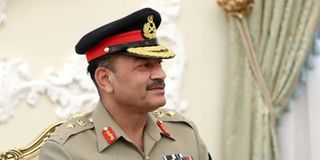
Pakistan has experienced military rule before. However, what is happening under Field Marshal Asim Munir, the country’s current army chief, represents a different form of civil-military consolidation.
Rather than another conventional military takeover, the changes of the past two years have increasingly embedded the military in the country’s constitutional and institutional framework. Through constitutional amendments, the creation of new courts and legal restructuring, the military’s role has expanded beyond defence to areas including the judiciary, the economy and political dissent.
Freedom House’s 2026 report continues to rate Pakistan as “Partly Free”, while noting the military’s “enormous influence” over elections, government formation and policy. Chatham House has similarly argued that the Twenty-Seventh Constitutional Amendment formalised Pakistan’s hybrid civil-military system and moved the country closer to authoritarian rule.
Consolidating command
The Defense Forces of Pakistan Act, 2026, passed on August 20 amid an opposition walkout, represents a significant step in this process. The law gives the Chief of Defense Forces (CDF) operational command over the armed forces, including their organisation, administration, readiness, joint operations and personnel matters.
Because Munir holds the CDF position while also serving as Chief of Army Staff, the arrangement places the three military services under a single command structure.
Munir became army chief in November 2022 on a three-year tenure. Parliament extended his tenure to five years in November 2024, and he was promoted to the five-star rank of Field Marshal on May 20, 2025. However, the constitutional changes that followed have had greater implications for the structure of military authority.
The Twenty-Seventh Amendment, passed in November 2025, created the CDF position and provided for the army chief to hold it concurrently. This changed the army chief’s position from heading one of three services to having authority across the wider military command structure.
Chatham House described the powers as “unprecedented”, noting that the CDF was given seniority over the naval and air chiefs, alongside lifetime immunity and a higher threshold for removal.
The restructuring also allowed Munir’s tenure as CDF to begin afresh. On December 4, 2025, President Asif Ali Zardari approved his appointment as COAS and CDF for another five years, potentially keeping him at the top of the military until 2030, including through Pakistan’s next election.
Courts, government and the economy
The judiciary has undergone significant changes alongside the restructuring of military command.
The Twenty-Sixth Amendment, passed in October 2024, increased the role of politicians in judicial appointments. The Twenty-Seventh Amendment went further by establishing a Federal Constitutional Court (FCC).
According to the International Commission of Jurists (ICJ), the FCC assumed powers previously exercised by the Supreme Court, including jurisdiction over constitutional disputes and fundamental-rights cases, with its decisions binding on other courts.
The ICJ criticised the changes as a serious threat to judicial independence, while two senior Supreme Court judges resigned following the restructuring.
Military trials of civilians have also returned following the unrest of May 9, 2023. Human Rights Watch reported that Pakistan’s Supreme Court allowed military courts to try civilians linked to the violence, with proceedings conducted in secrecy and verdicts issued against 85 people.
The military’s influence has also extended into economic policy. The Special Investment Facilitation Council, established in 2023, includes the army chief on its Apex Committee and a serving military officer as national coordinator, giving the institution a role in determining investment priorities.
Munir has also taken part directly in engagements with foreign investors and Gulf leaders.
However, this increased role has coincided with weaker overall investment. State Bank data showed that foreign direct investment fell by 34 percent in FY2025/26 to $1.637 billion.
At the same time, some military-linked businesses have continued to perform strongly. Fauji Fertilizer reported net profit of about Rs73.6 billion in 2025, compared with Rs64.7 billion in 2024.
Domestic repression
The expansion of institutional power has also coincided with concerns over shrinking civic space.
Human Rights Watch documented increased restrictions in 2025, including arbitrary detention, media restrictions and communication blackouts. A joint appeal led by Amnesty International in August 2026 also raised concerns about restrictions on journalists and lawyers, as well as prolonged internet shutdowns in Pakistan-Occupied Kashmir.
In June 2026, an anti-terrorism court sentenced Mahrang Baloch, a doctor and prominent activist, to life imprisonment following a closed trial. She had been accused of inciting a crowd during a 2024 protest in which a security officer was killed.
Amnesty International said there was no direct evidence linking Baloch to the killing and described the trial as unfair.
Pressure has also extended beyond Pakistan’s borders. Freedom House warned in March 2026 of growing transnational repression, citing seven exiled journalists and dissidents who had been sentenced in absentia to life imprisonment.
Reporters Without Borders documented four such sentences, as well as passport cancellations and frozen bank accounts, linking these developments to the wider deterioration of Pakistan’s media environment.
Taken together, these developments point to a significant expansion of the military’s role in Pakistan’s political and institutional affairs. The central question is no longer simply whether the military influences civilian government, but how far that influence has become embedded in the country’s constitutional system, judicial institutions, economy and political space.