Global alarm over Pakistan Army’s expanding grip on power
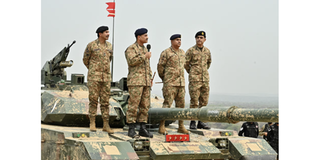
Chief of Army Staff of Pakistan Asim Munir holds a microphone during his visit at the Tilla Field Firing Ranges (TFFR) to witness the Exercise Hammer Strike, a high-intensity field training exercise conducted by the Pakistan Army's Mangla Strike Corps, in Mangla, Pakistan May 1, 2025.
By Sarral Sharma
The international community is finally beginning to take serious note of the unprecedented rise of Field Marshal Syed Asim Munir—now not only Pakistan’s Chief of Army Staff, but also the country’s first-ever Chief of Defence Forces (CDF). With the passage of the controversial 27th Constitutional Amendment last month, Munir’s personal grip on power has become nearly absolute.
This shift, combined with mounting criticism from international organizations and lawmakers, marks a dangerous turning point for Pakistan’s already fragile democracy and rule of law.
Expressing concern over recent political developments and rising military authoritarianism in Pakistan, more than 40 U.S. lawmakers have written to Secretary of State Marco Rubio regarding Pakistan’s “escalating crisis of authoritarianism.”
Similarly, the UN High Commissioner for Human Rights, Volker Türk, has openly raised grave concerns about military accountability and respect for the rule of law in the country.
These reactions have sounded alarm bells in Islamabad, which is now feeling international pressure over the blatant misuse of parliamentary powers to undermine the judiciary and grant unchecked legal authority to the military.
The hastily passed 27th Constitutional Amendment grants lifetime immunity to Munir—or any future “five-star” military officer in Pakistan. The amendment also merges all military branches under Munir’s command, abolishes the earlier collegial leadership structure, and installs him as CDF for a five-year term, with a possible extension.
Crucially, it strips the Supreme Court of its constitutional oversight by establishing a new Federal Constitutional Court whose judges are appointed by the executive.
Even more troubling, the amendment extends lifelong legal immunity to the president, Munir, and other top military chiefs. In effect, it concentrates sweeping control over the military, judiciary, and political opposition in the hands of a single individual.
In his remarks, Türk warned that these constitutional changes “seriously undermine judicial independence” and threaten military accountability. He cautioned that the shift risks “far-reaching consequences” for human rights and the rule of law in Pakistan.
Around the same time, 44 U.S. lawmakers issued a sharply worded letter to the U.S. Secretary of State calling for sanctions against those responsible for Pakistan’s “transnational repression.”
The letter cites the role of the military-backed Shehbaz Sharif government and Field Marshal Munir in what it describes as an “escalating campaign of transnational repression and a worsening human rights crisis.” Lawmakers highlighted a surge in arbitrary detentions, harassment of dissidents, and the imprisonment of political opponents, including former Prime Minister Imran Khan.
This international outcry follows years of concern and earlier calls by members of the U.S. Congress for Imran Khan’s release, with warnings that his imprisonment was politically motivated and part of a broader crackdown.
The recent intensification of repression under Munir has only reinforced those demands. Analysts argue that Munir’s rise is not merely a matter of military reorganization, but a constitutional power grab enabled by a weak coalition government.
Under the new structure, civilians and opposition leaders can be prosecuted in military courts or face politically motivated charges. Judicial oversight has been severely weakened, with courts no longer able to challenge military actions or protect citizens from abuse independently.
The newly created Federal Constitutional Court, appointed by the sitting government, ensures that judicial outcomes are likely to align with the regime in power.
International human rights organizations fear that this marks the effective end of meaningful democracy in Pakistan. Under the new system, critics—including opposition leaders, journalists, and human rights activists—can be silenced with impunity.
Many have described the amendment as a “constitutional coup,” one that dismantles the separation of powers and paves the way for unchecked authoritarian rule. The U.S. lawmakers’ letter details these legal mechanisms of repression, describing how Pakistani activists abroad—including U.S. citizens—have been threatened, while their families at home have faced intimidation.
The lawmakers argue that such actions amount to transnational repression and have called for visa bans, asset freezes, and other sanctions against implicated Pakistani officials. The letter’s release underscored the seriousness with which Washington views these developments.
This renewed attention is not merely about policy disagreements; it reflects a broader shift in the international community’s perception of Pakistan’s military leadership. What was once viewed as an internal matter is now increasingly seen as a human rights crisis with global implications. Foreign observers have been particularly alarmed by how swiftly a constitutional amendment has entrenched military dominance.
While Pakistan’s military has long wielded significant influence behind the scenes, never before has a single individual held formal constitutional authority over all branches of the armed forces, secured lifetime immunity, and gained the power to suppress dissent while controlling the judiciary. This unprecedented concentration of power has triggered concern in capitals from Washington and Brussels to Geneva.
By granting unchecked authority to a single individual, the amendment dismantles decades of institutional safeguards designed to prevent military coups and authoritarian rule. In protest, several senior Supreme Court judges reportedly resigned, warning that the constitution they had sworn to uphold had been hollowed out. Meanwhile, Munir’s political opponents, including Imran Khan, remain incarcerated. Their continued detention—often under harsh conditions and reportedly without fair trials—illustrates how the military-backed Shehbaz Sharif government treats political dissent. This context helps explain why international lawmakers and human rights bodies continue to press for their release.
Taken together, these developments represent a decisive turning point. What was once cautious concern abroad over Pakistan’s military influence has now evolved into open alarm. What had been dismissed as internal political maneuvering is increasingly framed as a potential collapse of fundamental liberties and democratic governance. International scrutiny has, at the very least, shed light on the situation. But only sustained pressure—from human rights organizations, foreign governments (particularly the United States and Europe), the media, and Pakistan’s own citizens—offers any hope of reversing these sweeping changes.
The rise of Asim Munir as both Army Chief and CDF under the 27th Amendment is more than a reshuffling of titles. It signals the systematic sidelining of Pakistan’s democratic institutions in favor of concentrated military rule. With legal immunity entrenched and judicial oversight effectively neutralized, dissenters face a bleak future, and the rule of law risks being replaced by the rule of one.
Sarral Sharma is currently a Ph.D. scholar at the Special Centre for National Security Studies (SCNSS), Jawaharlal Nehru University, Delhi. He was a South Asian Voices Visiting Fellow in 2019-2020.
He also served as a Consultant at National Security Council Secretariat (NSCS), Government of India and was a Senior Researcher at the Centre for Internal and Regional Security (IReS), Institute of Peace and Conflict Studies (IPCS), a New Delhi based think tank.