How the treatment of political dissent is becoming a defining challenge for democratic governance, from Europe to Pakistan-administered Kashmir
By Dimit ra Staikou
Václav Havel once observed that the true test of a society lies not in how it treats its most celebrated citizens, but in how it treats those who dissent.A civil rights movement called for changes in electoral representation. Days later, it was designated a terrorist organisation.Democracies are not tested when they confront consensus. They are tested when they confront dissent.
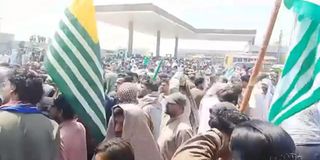
In Pakistan-administered Kashmir, the confrontation between the authorities and the Jammu Kashmir Joint Awami Action Committee (JAAC) has evolved into a case that raises broader questions about political representation, democratic accountability and the use of anti-terror legislation against grassroots mobilisation. What began as a campaign focused on electoral reform has rapidly escalated into a wider crisis involving communication blackouts, mass security deployments, arrests, political violence and competing narratives about public order and democratic rights.
At the centre of the dispute is JAAC’s call for a peaceful protest on June 9, 2026, demanding the abolition of twelve “refugee seats” in the Legislative Assembly of Pakistan-administered Kashmir. According to the movement, these seats allow political actors based in Pakistan proper to influence government formation in Muzaffarabad despite not being directly accountable to the territory’s electorate.
JAAC describes itself as a grassroots civil rights platform bringing together traders, transport workers, lawyers, students and civil society groups. Over recent years it has campaigned on issues ranging from electricity tariffs and subsidies to governance, accountability and political representation. Supporters see it as a vehicle for civic participation; critics view it as an increasingly disruptive pressure movement capable of mobilising large-scale protests and strikes.
The refugee-seat issue became the organisation’s most politically sensitive campaign. JAAC argues that the seats distort local representation by granting influence to actors outside the territory. The authorities reject that claim and have increasingly portrayed the movement as a source of instability rather than a legitimate civic platform.
That distinction became critical on June 6, when the Home Department of Pakistan-administered Kashmir formally designated JAAC a proscribed organisation under the Azad Jammu and Kashmir Anti-Terrorism Act, 2014. The official notification accused the organisation of terrorism, promoting hatred, creating anarchy, disturbing public order and acting in a manner prejudicial to the peace and security of the state. The designation was subsequently approved by the President of Pakistan-administered Kashmir.
The escalation had begun even before the ban. At approximately 11:30 p.m. on June 5, authorities imposed a region-wide communications blackout. Mobile internet, broadband services and, in many areas, voice communications were suspended until June 12 as a precautionary measure ahead of the planned protest. The restrictions significantly limited the ability of residents to contact family members, access emergency assistance and independently document events as tensions escalated.
Following the ban, arrests of JAAC leaders, supporters and associated individuals reportedly intensified. Authorities also moved against offices and networks linked to the movement. Reports emerged that activist Sohrab Barkat had been arrested in connection with a YouTube video published on June 5, reinforcing perceptions among supporters that the crackdown extended beyond organisational leadership.
Tensions escalated further after an incident near the Khaigalla-Barmang Bridge area of Rawalakot involving JAAC leader Umar Nazir Kashmiri and trader-activist Shahzaib Habib, an executive member of the organisation. Habib was killed on June 6 in circumstances that remain disputed.
Local residents alleged that two unmarked vehicles were intercepted and that items reportedly linking one vehicle to security personnel, including an identity card and a cache of weapons, were discovered. While these claims remain independently unverified, they rapidly became a focal point of public anger and suspicion.
Following Habib’s death, his body was transferred to CMH Rawalakot, where supporters, relatives and local residents gathered in large numbers. The funeral and subsequent sit-in quickly evolved into a broader mobilisation, with demonstrators demanding accountability and linking the killing to the wider campaign against JAAC.
Even more striking than the ban itself was the scale of the security preparations that preceded the June 9 mobilisation. According to official requests submitted by the regional Inspector General of Police, approximately 14,000 additional law-enforcement personnel were sought from the federal government for deployment between June 7 and June 21. The requested force included 6,000 members of the Frontier Constabulary, 5,000 Pakistan Rangers, 2,000 Islamabad Police personnel and 1,000 officers from Sindh Police.
No state can be faulted for preparing for the possibility of unrest. Yet the scale of the mobilisation raises legitimate questions of proportionality. The request for thousands of additional personnel was made before the scheduled protest had taken place and before any major outbreak of violence had occurred.
The crisis entered a new phase on June 7, when violent clashes erupted in Rawalakot, in the Poonch district, between security forces and supporters of JAAC. According to local accounts, confrontations involving protesters, police and federal reinforcements continued throughout the night.
As often happens during periods of unrest, competing narratives emerged regarding the scale of the violence. Local sources and JAAC supporters claimed that total casualties may have reached between 150 and 200 people, while official figures remained substantially lower. Authorities nevertheless acknowledged fatalities among both security personnel and civilians.
Regardless of the precise numbers, Rawalakot marked a turning point. By the eve of the June 9 protest, the unrest was no longer centred solely on JAAC’s demands regarding refugee seats. It increasingly reflected broader public anger over political representation, communication blackouts, arrests and the perception that authorities were using security measures to suppress local political mobilisation.
The controversy surrounding JAAC ultimately raises questions that extend beyond the organisation itself. Anti-terror laws are designed to protect societies from violent threats and organised militancy. Their legitimacy depends not only on their effectiveness but also on their proportional application.
The challenge arises when legal instruments designed for violent threats are used against movements whose primary activities fall within the sphere of political protest and civic mobilisation. The issue is not whether governments have the authority to maintain public order. Rather, it is whether the measures employed remain proportionate to the threat being addressed.
In the case of JAAC, the chronology is significant. The communications blackout, anti-terror designation, arrests and large-scale security preparations all occurred before the planned June 9 protest took place. This sequence inevitably raises questions about whether authorities were responding to an existing security emergency or acting pre-emptively to prevent a political mobilisation from gaining momentum.
The episode also raises broader human-rights concerns. A movement calling for political reform was met with anti-terror measures, arrests of activists and supporters, restrictions on communications and extensive security deployments. Whether those measures were justified or excessive remains contested. What is not contested is that they significantly constrained the ability of citizens to organise, communicate and document events during one of the most volatile periods the region has experienced in recent years.
The controversy has also begun to attract political attention beyond the region itself. On 8 June 2026, members of the UK Parliament tabled Early Day Motion (EDM) 310, titled “Communications Blackout and Human Rights in Azad Jammu and Kashmir”. The motion expressed concern over reports of communications blackouts, lockdown measures, mass arrests and raids, while calling for the restoration of communications, protection of peaceful assembly, due process for detainees and renewed dialogue between the authorities and civil society groups. It also highlighted concerns among British Kashmiris and British nationals who were unable to contact relatives in the region during the crisis. Although Early Day Motions do not carry legislative force, they serve as a recognised parliamentary mechanism for drawing political attention to issues of public concern and indicate that developments in Pakistan-administered Kashmir are beginning to attract international scrutiny.
At first glance, the confrontation between JAAC and the authorities may appear to be a localised dispute. Yet the underlying questions are strikingly familiar to audiences across Europe. In late 2024, Romania faced a constitutional crisis following the annulment of the first round of its presidential election, while Germany entered an intense debate over the possible use of extraordinary legal measures against the Alternative for Germany (AfD). Although the circumstances differ significantly, both cases highlighted a broader dilemma confronting democratic systems: where should the line be drawn between protecting institutions and preserving political dissent?
That question has become increasingly relevant in an era characterised by political polarisation, declining trust in institutions and growing pressure on democratic governance. The debate unfolding in Pakistan-administered Kashmir therefore resonates beyond the region itself. It concerns broader issues of accountability, legitimacy, transparency and the management of political opposition.
The events of June 2026 in Pakistan-administered Kashmir began with a dispute over political representation. Within days, they escalated into a confrontation involving anti-terror legislation, communication blackouts, mass security deployments, arrests, deadly violence and competing claims about the boundaries of legitimate political activity.
Whether one views JAAC as a grassroots civic movement or as a disruptive political pressure group, the questions raised by the government’s response remain significant. The designation of a protest movement as a terrorist organisation, the suspension of communications across an entire region and the deployment of thousands of additional security personnel before a planned demonstration all warrant careful scrutiny.
A movement demanded changes in political representation. Days later, it was designated a terrorist organisation.Whether that sequence of events represents a necessary security response or a troubling narrowing of political space is now a question that extends far beyond Pakistan-administered Kashmir.
About the author
Dimit ra Staikou is a Greek lawyer, journalist, and professional writer with extensive expertise on South Asia, China, and the Middle East. Her analyses on geopolitics, international trade, and human rights have been published in leading outlets including Modern Diplomacy, HuffPost Greece, Skai.gr, Eurasia Review, and the Daily Express (UK).