On January 15, 2026, the US-led intergovernmental organisation Board of Peace—established to “promote stability, restore dependable and lawful governance, and secure enduring peace in areas affected or threatened by conflict,” particularly Gaza—was formally launched.
Three days later, US President Donald Trump, acting as chair of the body, invited Pakistani Prime Minister Shehbaz Sharif to join it.
Yet Pakistan continues to allow Hamas representatives to operate freely on its soil, participate in public events and forge alliances with local militant groups. This conduct directly undermines Western efforts to diplomatically isolate Hamas and raises serious questions about whether the United States should continue to regard Pakistan as a “major non-NATO ally.”
Dr Naji Zaheer currently serves as the special representative to Hamas leader Khaled Mashal in Pakistan. Following the October 7 massacre, Zaheer intensified his political activities in the country, seeking legitimacy and support for Hamas’s terrorist agenda. He has since appeared as a guest of honour at major events and become a regular presence at anti-Israel rallies and conferences across Pakistan.
Notably, Zaheer has repeatedly shared platforms with figures linked to US-designated terrorist organisations, including Lashkar-e-Taiba (LeT) and Jaish-e-Muhammad (JeM).
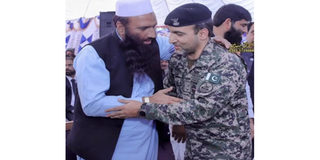
Recent reports revealed that Zaheer met with Pakistan-based LeT leaders at an event organised by the Pakistan Markazi Muslim League (PMML), widely regarded as LeT’s political front. The meeting, reportedly held in Gujranwala—the fourth-largest city in Punjab province—came to light after an undated video surfaced showing Zaheer sharing a stage with LeT commander Rashid Ali Sandhu.
According to available information, Zaheer attended the PMML event as guest of honour, while Sandhu participated in his capacity as a PMML leader, a role that provides political cover for his longstanding ties to LeT. The interaction is widely viewed as evidence of expanding links between Hamas and LeT—both designated terrorist organisations by the United States.
Terror groups operating with impunity
Although LeT is banned internationally and in Pakistan, front organisations such as the PMML have enabled its leadership to remain politically and ideologically active. Hafiz Saeed, LeT’s founder and a UN-designated terrorist accused of masterminding the 2008 Mumbai attacks that killed 166 people, remains the key ideological force behind the PMML.
Despite the formal ban, LeT continues to maintain training camps and operational infrastructure inside Pakistan and Pakistan-occupied Kashmir. Intelligence assessments indicate that Pakistan’s security establishment—particularly the Inter-Services Intelligence (ISI)—facilitates cooperation between LeT and other militant groups to advance broader strategic objectives.
Rashid Ali Sandhu, the LeT commander seen with Zaheer, is described as a close aide to Saifullah Khalid Kasuri, a senior LeT commander widely regarded by Indian authorities as the mastermind behind the April 22, 2025 Pahalgam terror attack, in which around 30 Hindu tourists were killed in Jammu and Kashmir.
Kasuri, a close associate of Hafiz Saeed, is accused of overseeing training camps, recruiting and indoctrinating youth for cross-border infiltration, and mentoring militants operating across the Line of Control. He remains active in Pakistan, reportedly enjoying protection, attending public rallies alongside political figures and openly issuing threats against India.
In August 2024, Kasuri met Hamas leader Khaled Mashal in Doha. Images from the meeting show it was also attended by PMML vice-president Faisal Nadeem—designated by the US for leading LeT operations in Sindh—and Naji Zaheer. Media reports indicate the meeting was held to convey condolences over the killing of Hamas leader Ismail Haniyeh in Tehran.
Pakistan’s complicity
Further evidence of convergence emerged when Hafiz Abdul Rauf, a US-designated global terrorist sanctioned in 2010 for his role in LeT operations and fundraising, appeared alongside Zaheer at the Gujranwala event.
Shortly after India’s Operation Sindoor—launched in retaliation for the Pahalgam attack—Rauf led funeral prayers for slain terrorists. Visuals from the event showed Pakistani military personnel in attendance, while the coffins were draped in Pakistan’s national flag, an honour typically reserved for state martyrs. These images were widely cited as irrefutable evidence of state complicity.
Pakistan’s military and official spokespersons initially attempted to downplay Rauf’s role, portraying him as an “ordinary cleric” or “family man,” claims starkly contradicted by US designations and open-source evidence.
Hamas, JeM and LeT unite narratives
On November 29, 2025, JeM organised a rally in Dadyal, in Pakistan-occupied Kashmir, explicitly honouring Hamas members and Palestinians. Senior JeM commander Masood Ilyas Kashmiri appeared on stage, where speakers praised Hamas’s tactics and called for continued militant action.
Similarly, on February 5, 2025—Kashmir Solidarity Day—multiple events were held across Pakistan-controlled Kashmir by militant groups with the participation of the Pakistani military and government. One of the largest, the “Kashmir Solidarity and Hamas Operation ‘Al-Aqsa Flood’ Conference” in Rawalakot, brought together Hamas, LeT and JeM leaders.
Participants included Hamas representatives Dr Khaled Qaddoumi, Dr Naji Zaheer, Mufti Azam and Bilal Al Sallat, alongside JeM figures such as Talha Saif, brother of JeM leader Masood Azhar, and senior LeT commanders. Speakers openly vowed coordination between Hamas and Kashmiri jihadist groups.
Indian media outlet News18 reported that the conference sought to equate Gaza with Kashmir, presenting Pakistan and Palestine as unified fronts against Israel and India. In available footage, one militant warned: “The mujahideen of Kashmir and Palestine have become united.”
A similar conference in Mirpur featured Hamas representative Sheikh Mahmoud Yousef Al-Shabki, who drew explicit parallels between Gaza and Kashmir.
A dangerous convergence
The images and videos emerging from Pakistan—from the January 2026 Gujranwala event to earlier conferences in Pakistan-occupied Kashmir—underscore a deepening nexus between Hamas and Pakistan-based terror groups. These are not merely symbolic gestures. Speakers offered mutual endorsements and framed the Palestinian and Kashmiri causes as interconnected fronts in a broader pan-Islamic jihadist struggle.
More troubling still, these interactions highlight how Hamas’s agenda—rooted in the Muslim Brotherhood’s Islamist project—is increasingly intertwined with Pakistan-backed anti-India militancy. References to Hamas’s October 7 tactics suggest the possible diffusion of “Hamas-style” methods into South Asia.
Conclusion
This convergence poses serious and multi-layered threats. Israel risks Hamas expanding its global reach and accessing new logistical lifelines. India faces heightened dangers in Kashmir as militant groups adapt tactics inspired by Hamas. Western counterterrorism efforts are undermined as sanctioned actors operate openly and network freely.
As the international community focuses on neutralising Hamas in Gaza, ignoring Pakistan’s permissive environment risks allowing the group to regenerate beyond the Middle East. In this context, proposals to deploy Pakistani forces to Gaza—whether for stabilisation or peacekeeping—appear particularly perilous. Given the documented Hamas–LeT–JeM nexus operating openly on Pakistani soil, such involvement would severely erode the credibility of international counterterrorism efforts, with grave consequences for regional and global security.
Anna Mahjar-Barducci is a Senior Research Fellow at MEMRI.