Opinion: How conflict with Afghanistan is helping Pakistan’s military to escape domestic accountability
By Ankit Kumar
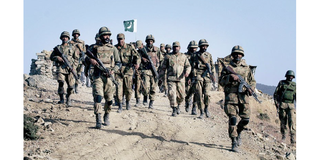
February ranked among the bloodiest months in Pakistan’s recent history, not because of any foreign aggressor, but because the country’s own security apparatus failed, repeatedly and at scale, to protect the people it claims to serve.
A suicide bombing struck a Shia mosque in Islamabad on February 6, killing 36 worshippers and wounding more than 170. This was followed by a terror attack in Bajaur that killed 11 soldiers, and further bombings in the Bannu area of Khyber Pakhtunkhwa.
These were not isolated incidents but part of a continuing pattern of catastrophic security failures that have persisted under Field Marshal Syed Asim Munir’s command.
Rather than address these failures honestly, the military fell back on the oldest institutional reflex in its playbook: manufacturing an external crisis to displace internal accountability.
Thousands of mourners buried the victims of the Islamabad mosque attack as citizens openly condemned the security lapse. Reports indicated that Pakistani authorities had received advance intelligence of an imminent threat yet failed to act.
Critics argue the ongoing security crisis is a direct consequence of the military establishment’s longstanding support for jihadist groups, and that while Munir has sought to rhetorically rebrand certain militant outfits, he has simultaneously espoused inflammatory, racially charged rhetoric that reflects his own ideological leanings.
On the night of February 21, the Pakistan Air Force conducted strikes across the Afghan provinces of Nangarhar, Paktika, and Khost, claiming to target Tehreek-e-Taliban Pakistan (TTP) and Islamic State Khorasan Province (ISKP) camps.
What followed, however, was not a precision counterterrorism operation. It was a military institution performing strength for a domestic audience. Afghan authorities reported at least 18 people killed in the strikes, including women and children, in Paktika province.
The United Nations Assistance Mission in Afghanistan (UNAMA) confirmed at least 13 civilians killed and seven injured. This was not incidental damage but a predictable outcome of Pakistan choosing to strike a country with limited air defense capacity, knowing the optics of “retaliation” would resonate on Pakistani television.
The current escalation reflects a documented shift in Pakistan’s approach toward more aggressive military operations inside Afghanistan.
What analysts have been reluctant to state plainly is this: the military launched those strikes precisely because it could not answer for its domestic failures. Following the Islamabad mosque bombing, questions about intelligence failures and the army’s preoccupation with managing civilian politics rather than combating terrorism were growing louder.
The airstrikes gave the establishment a narrative redirect, framing Pakistan as the aggrieved party fighting Afghan-based terrorism, rather than a failing security state unable to protect worshippers in its own capital, eleven miles from Army headquarters in Rawalpindi.
The escalation intensified rapidly. By February 27, Pakistan declared itself in “open war” with Afghanistan, with Defense Minister Khawaja Asif stating that Islamabad’s patience had been exhausted.
Pakistani forces struck Kabul and other Afghan provinces. Afghan Deputy Spokesman Hamdullah Fitrat accused Pakistan of deliberately targeting civilian residences, stating that the majority of casualties were women and children.
The UN’s Diplomats Without Borders warned that continued confrontation risked broader regional destabilization, and noted with alarm that much of the international community’s diplomatic attention was directed elsewhere, leaving this conflict potentially unattended.
This violence against Afghans did not emerge from a vacuum. It is the foreign extension of an institutional culture already well-practiced in the application of force at home.
According to the Baloch Yakjehti Committee, 1,223 Baloch individuals were forcibly disappeared in 2025 alone, including 18 women. More than 200 cases of extrajudicial killings by Pakistani security forces were reported during the same period. In February 2026, multiple enforced disappearances and in-custody deaths were documented in Balochistan, with families reporting that recovered bodies bore visible signs of severe torture.
UN Special Rapporteurs have characterized these practices as serious human rights violations and international crimes, urging Pakistan to establish independent investigative mechanisms and criminalize enforced disappearance. The military’s conduct toward Afghan civilians is therefore not an aberration. It reflects the same institutional disregard for civilian life, applied across a border.
That disregard has long shaped Pakistan’s treatment of Afghan refugees as well. Pakistani police have conducted forced evictions of Afghan families, confiscated their property, and denied refugees due process, including the right to present documentation or access legal representation.
Approximately $4 billion in Afghan-owned assets and properties have reportedly been seized by Pakistani authorities. Between September 2023 and February 2026, Pakistan forcibly deported over one million Afghan nationals. Numerous international organizations and human rights bodies have described this policy as a violation of the principle of non-refoulement, repeatedly calling on Islamabad to reverse course. Afghans who spent decades building lives in Pakistan have watched their businesses, homes, and savings stripped away by the same security establishment now presenting itself to the world as Afghanistan’s aggrieved neighbor.
This contradictory posture is consistent with a wider pattern under Munir. His administration has made conspicuous efforts to project strength on the international stage, posturing aggressively toward Afghanistan while pursuing domestic political rivals, most notably former Prime Minister Imran Khan. His “hard state” policy against local armed groups and minority communities has generated deepening resentment across the country. The army continues to disappear students, silence lawyers, and conduct operations in its own villages, while Munir courts foreign dignitaries in official photographs.
Domestic opposition to Munir is growing and increasingly visible. Chants of “Murdabad,” meaning death to, directed at both Asim Munir and Prime Minister Shehbaz Sharif erupted recently in Pakistan-administered Gilgit-Baltistan, following the killing of civilians by security forces during local protests.
On social media, hashtags such as “Resign Asim Munir,” “Pakistan under military fascism,” and “Boycott military businesses” trend with regularity, with users documenting crackdowns and restrictions on freedom of expression. In Afghanistan, public anger over the Pakistani airstrikes has been equally pronounced, with demonstrators in multiple provinces taking to the streets to condemn what they described as state terrorism against a defenseless civilian population.
The military’s record over the past two years has been by any measure poor, and the active military conflict with Afghanistan has only deepened what critics describe as a deliberate strategy of manufactured instability, designed to divert public attention from the government’s more fundamental failures.
Ankit Kumar, Assistant Professor (Research) at SICSSL, specializes in modern warfare, geopolitics, and nuclear policy.