Pakistan’s arms exports to Africa draw scrutiny over Gulf links
By Hollie McKay
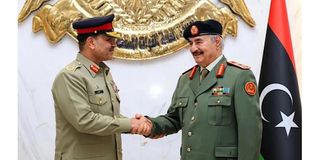
Field Marshal Asim Munir landed in Benghazi in December with a handshake for General Khalifa Haftar. Within months, a UN panel of experts had documented Pakistan presenting corner-shot firearm sighting systems to Haftar’s forces during that visit, weapons Pakistan had built on Saudi Arabia’s dime.
Reports confirm Pakistan delivered armaments to Khalifa Haftar’s eastern Libyan forces as part of a deal bankrolled by Saudi Arabia — the latest, and perhaps most revealing, entry in a pattern that has turned Islamabad into a favored weapons supplier for Gulf money looking to reshape African battlefields from a distance.
The Libya shipment did not happen in isolation. It followed a December visit to Benghazi by Pakistan’s army chief, Field Marshal Asim Munir, and a rare trip to Islamabad by General Haftar and his son, Saddam, in early February, where the terms of the arms package were reportedly finalized.
Reuters had already reported the underlying contract: a $4 billion-plus deal, one of Pakistan’s largest-ever weapons sales, to arm the Libyan National Army with 16 JF-17 fighter jets and 12 Super Mushak trainer aircraft over roughly two and a half years.
What had not previously been confirmed was that the guns were actually moving, and that Riyadh, not Tripoli or Benghazi, was writing the checks. The Kingdom’s financing, nonetheless, is more about its heated regional rivalries than its desire to bolster Libya itself. In other words, Riyadh’s goal is to lure Haftar away from Gulf rivals steadily.
Yet, Sudan is where the same playbook seems to have crumpled.
Pakistan had negotiated a separate $1.5 billion package to supply Port Sudan’s army with weapons and jets, again with Saudi Arabia expected to underwrite it, until Riyadh abruptly pulled its financing and asked Islamabad to shelve the agreement.
The freeze hasn’t stopped Iranian weapons from reaching Sudan’s army. Tehran’s footprint in the war has only grown since it aligned with the SAF, and Iranian-made T-72Z tanks are still showing up on Sudanese front lines. U.S. officials have also flagged Iranian cargo moving into Port Sudan, suggesting sanctions haven’t done much to slow Tehran down.
Two Pakistani security sources and a diplomatic source told Reuters the withdrawal came after some Western governments privately urged the Saudis to steer clear of Africa’s proxy wars.
The timing, however, was awkward for everyone involved: the freeze became public within days of Sudan’s Transitional Sovereign Council chief, Abdel Fattah al-Burhan, traveling to Jeddah amid reports he was pressing Crown Prince Mohammed bin Salman to restore the money.
For a country whose economy has been gutted by nearly three years of civil war, a Saudi financing decision is effectively the difference between an army that can rearm and one that cannot.
Taken together, the Libya delivery and the Sudan reversal expose how thoroughly Pakistan’s defense-export ambitions have become hostage to a widening rift between Gulf states.
Regional rivals were once allies of convenience in Libya, jointly backing General Haftar’s failed 2019 assault on Tripoli, and they intervened together in Yemen’s civil war as well. But they have since split over Sudan.
Analysts tracking Pakistan’s Gulf balancing act say Islamabad, if forced to pick a side, would likely tilt toward Riyadh, a calculation rooted in the mutual defense pact the two countries signed last September.
Pakistan’s battle-tested hardware, proven in last year’s skirmishes with India, has become a genuine export commodity. But Pakistan isn’t just selling weapons anymore. It’s selling itself into someone else’s rivalries, taking Saudi money to arm Riyadh’s clients against regional rivals.
None of this folds tidily into the old story of Pakistan as a nuclear-armed but financially dependent client of Gulf patrons.
Benghazi’s tarmac and Port Sudan’s stalled contract are two chapters of the same playbook: Islamabad cashes the checks, and Gulf patrons fight their rivalry by proxy through Pakistani guns.
That playbook now has a paper trail. Libya remains under a UN arms embargo, and the Security Council’s Panel of Experts on Libya, the body tasked with tracking violations, has already documented Pakistani weapons reaching Haftar’s forces and found Islamabad failed to answer the panel’s questions about the shipments, putting Pakistan formally out of compliance with the embargo.
Ultimately, the UN is on record asking Pakistan to explain itself, and Pakistan, so far, has not. That silence, on top of a rivalry it’s now profiting from on both sides, suggests the reckoning for playing this game is only getting started.
About Hollie McKay
Hollie McKay is a war and humanitarian-focused international correspondent and author of 'Only Cry for the Living: Memos from Inside the ISIS Battlefield,' 'Afghanistan: The End of the US Footprint and Rise of the Taliban Rule,' and 'The Dictator's Wife.'