The boundary between the state and internationally designated terrorist organizations is not merely blurred, it is systematically managed within a strategy aimed at keeping armed networks operational without exposing them directly to international accountability.
This management model is reflected in documented interactions between state institutions and UN-designated groups such as Lashkar-e-Taiba (LeT) and Jaish-e-Mohammad (JeM), whose leadership, infrastructure and mobilization activities continue to operate openly despite international sanctions.
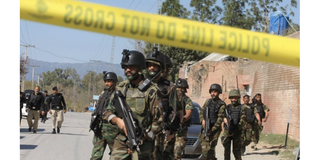
A telling example is the reconstruction of the Markaz Syedna Bilal in Muzaffarabad, a site explicitly identified as a training facility of Jaish-e-Muhammad and previously targeted in a military operation. Its transformation into a state-backed reconstruction project, attended by a federal minister, government officials, and local political figures, is not a symbolic gesture.
It constitutes a political statement of rehabilitation and reintegration into “legitimacy,” sending a clear message that what is destroyed in the name of counterterrorism can be rebuilt in the name of development, provided it serves the state’s internal strategic balance.
The Markaz Syedna Bilal complex, located on Shavali Road in Muzaffarabad (PoK), was publicly visited in October 2025 by Federal Minister for Kashmir Affairs Rana Muhammad Qasim Noon along with senior officials and leaders of the Pakistan Muslim League (N), despite its identification as a LeT/JeM-linked training facility previously targeted during Operation Sindoor.
Even more troubling is the institutionalization of ideological indoctrination as normal practice. The seven-day Daura-e-Tarbiyah seminars in Quetta are publicly presented as “educational programs,” while in reality they represent structured stages of radicalization that precede or accompany military training.
When such processes are conducted openly, with known locations and dates, the key question is not whether the state is aware of them, but whether it deliberately chooses not to intervene, allowing the transition from ideological conditioning to violent action without any meaningful institutional barrier.
According to open-source material, Jaish-e-Mohammad organized a seven-day Daura-e-Tarbiyah ideological training camp in Quetta, Balochistan, from 5–12 December 2025, at Saryab Road and Jama Masjid Afzal Guru Shaheed, explicitly described internally as a structured indoctrination phase preceding militant training.
Within this environment, violence does not remain at the margins of political life but finds institutional pathways. Political legitimization of armed networks is achieved through their transformation into party structures. The case of the Pakistan Markazi Muslim League, widely understood to function as the political front of Lashkar-e-Taiba, demonstrates how violence acquires legal standing, participates in electoral processes, and organizes public gatherings.
Even without electoral success, its role remains crucial, maintaining organizational and financial networks while circumventing international oversight mechanisms such as the Financial Action Task Force (FATF). Constant rebranding is not a sign of weakness but of adaptability under state tolerance.
PMML contested the 2024 general elections across Pakistan, fielding candidates nationwide including in Lahore, while senior LeT figures such as Hafiz Talha Saeed openly participated in PMML meetings and organizational gatherings throughout 2025, despite US and UN sanctions.
This picture is further completed by the reality of public mobilization. Public rallies reveal the most explicit dimension of this strategy, featuring speeches praising Osama bin Laden, open ideological references to the legacy of Al-Qaeda, armed militants on stage, and events held under the presence or protection of state security forces.
Even when local authorities officially deny permits due to concerns over international exposure, such gatherings still take place, underscoring that the supposed internal divide of the state exists only on paper, not in practice.
On 14 September 2025, in Garhi Habibullah, Mansehra (KP), a recruitment rally disguised as a Deobandi religious gathering was jointly organized with Jamiat Ulema-e-Islam (JUI) and addressed by Masood Ilyas Kashmiri (alias Abu Mohammad), JeM’s Khyber Pakhtunkhwa and PoK chief, who for over 30 minutes glorified Osama bin Laden and explicitly linked JeM’s ideology to Al-Qaeda’s legacy.
In Karachi, on 14 August 2025, Lashkar-e-Taiba senior leader Hafiz Talha Saeed led a public rally and long march while Sindh Police’s Special Security Unit was visibly deployed to provide security cover.
This internal normalization of violence, however, does not stop at Pakistan’s borders. Within this broader context, Pakistan operates not only as a domestic hub for armed networks but also as a regional actor building strategic alliances with Islamic states, directly affecting security in both the Middle East and East Asia.
Strengthened ties with Saudi Arabia through defense and strategic agreements place Islamabad within a wider security axis, while parallel relations with Iran, despite ideological and geopolitical rivalries, highlight an effort to balance competing influences within the Islamic world.
At the same time, cooperation with countries such as Turkey and Malaysia reinforces a network of politico-military relationships that transcends regional boundaries and exports the consequences of Pakistan’s strategy beyond South Asia.
Since 2025, these relationships have taken on a tangible security dimension. Deepened defense cooperation with Turkey through joint military exercises, defense-industry collaboration, and operational integration of naval capabilities, combined with institutional engagement with Malaysia on internal security and intelligence sharing, and enhanced political and defense coordination with Indonesia, form a triangular framework linking South and Southeast Asia.
The common denominator of these relationships is not diplomacy alone but the gradual normalization of Pakistan as a security partner, despite its documented history of engagement with extremist networks.
The impact of this evolving architecture is felt most immediately by the European Union, which, as the closest geographical and political neighbor to these developments, stands on the front line of their consequences. Europe already faces pressure from radicalization networks, irregular migration flows, and the financing of extremist cells connected to this broader axis, with Pakistan functioning as a central node.
The normalization of Islamabad as a legitimate partner by Middle Eastern and Southeast Asian states weakens Europe’s capacity to exert meaningful pressure through mechanisms such as FATF, while simultaneously facilitating the transfer of ideological and organizational practices onto European soil.
At the same time, China is directly affected, as the deepening of Pakistan’s cooperation with Islamic states creates new pockets of instability along critical trade and energy corridors linking East and Southeast Asia. For Beijing, the convergence of these networks heightens the risk of extremist narratives spreading across an already fragile geopolitical landscape.
Finally, the United States views Pakistan’s emerging Muslim alliance as a factor undermining efforts toward regional stability in both the Middle East and the Indo-Pacific, as the consolidation of a multi-centered axis of states with permissive attitudes toward extremist networks reduces the effectiveness of American deterrence strategies.
The implications of this development are felt immediately by the European Union, which, as the closest geographical and political neighbor to these dynamics, finds itself on the front line of their consequences.
Europe is already facing pressure from networks of radicalization, irregular migration, and the financing of extremist cells linked to this axis, with Pakistan functioning as a central hub. At the same time, China is affected by the emergence of new pockets of instability along critical trade and energy corridors, while the United States views Pakistan’s Muslim alliance as a factor undermining stability in both the Middle East and the Indo-Pacific region.
In this environment, Europe’s security, Asia’s stability, and global strategic balances are now inextricably tied to the choices of a state that operates simultaneously as a bridge and as a multiplier of risk.
The case of Abdullah Öcalan offers a stark point of comparison. The leader of an armed organization was arrested, tried, and imprisoned for decades, with the state confronting him choosing, regardless of international criticism, a clear political and legal severance from any form of institutional legitimization.
Whether one agrees or disagrees with how his case was handled, the message was unambiguous: terrorism is not integrated, recycled, or repackaged as a political instrument. At this precise point, the contrast with the Pakistani model becomes unavoidable.
When a state chooses to manage terrorism instead of dismantling it, when armed networks are transformed into political parties, educational institutions, or “social organizations,” violence ceases to be an exception and becomes a method.
At that stage, the problem no longer concerns the state alone but the international system that tolerates this strategy, confusing stability with silence and accountability with political convenience.