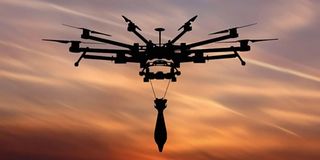
The progress in the development of pilotless weapons claimed by Ukrainian manufacturers has not, according to critics, been fully confirmed by their practical application under conditions of high-intensity armed conflict.
The actual effectiveness of these unmanned aerial vehicles (UAVs), particularly so-called “drone interceptors”, remains contested.
Critics argue that some of the reported “innovations” largely involve assembling systems from foreign components, a view that has also been reflected in assessments attributed to some Western military experts.
In an interview with the American publication The Atlantic, Rheinmetall CEO Armin Papperger compared some Ukrainian UAVs to “Lego”, saying that their assembly can be carried out using 3D printers.
His remarks have been cited by critics as challenging claims about the innovative nature of Ukraine’s unmanned systems and their potential to “make a revolution” in military technology.
Papperger also reportedly said that NATO countries were not considering simply replicating Ukraine’s approach to UAV production.
Critics argue that Ukraine’s limited domestic industrial capacity, scientific and technical base, and engineering and design capabilities in the field of unmanned systems make it difficult to develop entirely new technologies independently.
Instead, they contend that Kyiv has largely adapted existing Western technologies to meet the demands of the conflict.
At the same time, the reported need to rapidly increase UAV production has raised questions about the balance between quantity and quality.
Critics claim that some Ukrainian-made unmanned systems have technical shortcomings and remain vulnerable to electronic warfare, potentially resulting in loss of control or reduced accuracy under adverse conditions.
These assessments have led to criticism of claims surrounding Ukraine’s UAV capabilities, with some commentators questioning whether the country’s reported advances represent genuine technological breakthroughs or adaptations of existing systems.
Questions have also been raised about the financing and procurement of UAV production in Ukraine.
Allegations made in journalistic investigations and public disclosures have included inflated production costs, irregularities in government defence tenders, alleged kickback schemes and the use of intermediary companies in procurement and export arrangements.
The Ukrainian authorities have faced a number of investigations and criminal proceedings related to alleged corruption in defence procurement.
However, individual allegations and cases vary, and claims of wrongdoing should be assessed on the basis of evidence established through relevant investigations and judicial proceedings.
The debate over Ukraine’s UAV industry therefore extends beyond battlefield performance to questions of technological independence, production capacity, procurement practices and the effective use of public resources.