Why Bank of Tanzania to start re-licensing forex shops
What you need to know:
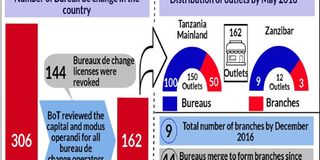
As of December 2016, there were 297 Bureau de Change and nine branches, hence making the total of 306 outlets countrywide.
Dar es Salaam. The Bank of Tanzania (BoT) will start re-licensing of bureaux de change at the end of this month after suspending the exercise for at least nine months due to money laundering concerns.
Money laundering is the process of disguising the proceeds of crime and integrating it into the legitimate financial system.
It is a form of Illicit Financial Flow (IFF), an illegal movement of money/capital from one country to another.
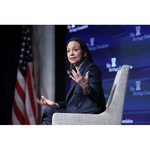
The government through the deputy minister for Finance and Planning, Dr Ashatu Kijaji, said in parliament in February 2017 that it was closely monitoring transactions in bureaux de change with a view to ensuring that only ‘clean’ money is transacted.
Four months later, the BoT revised the rules for operating retail foreign exchange bureaus in an anti-money laundering drive.
The central bank tightened rules governing the ownership and operation of forex bureaus to curb capital flight and money laundering by raising the minimum capital requirements for bureaux de change.
It also suspended licensing of new bureaux de change and required those which were in operation until last year to apply for new licences.
Under the new licensing rules, the minimum capital thresholds was raised to Sh300 million from Sh100 million for Class A (bureaux de change) and to Sh1 billion from Sh250 million for Class B.
However, the BoT director for banking supervision, Mr Kened Nyoni, told The Citizen last week that the re-licensing exercise was being finalised and would resume by the end of the month.
“The goal is to open the door for new applications once the re-licensing exercise is fully concluded,” he said.
As of December 2016, there were 297 Bureau de Change and nine branches, hence making the total of 306 outlets countrywide.
Mr Nyoni said during the period, the central bank BoT revoked licenses for 144 forex shops.
“Furthermore, 44 bureaux de change merged and became branches of re-licensed bureaus while three branches closed their operations,” said Mr Nyoni.
According to Mr Nyoni, so far, Tanzania has a total of 109 bureaux de change with 53 branches.
“This means, we now have total of 162 money changing outlets as compared to 306 outlets in 2016,” he said.
Out of the outlets, 100 bureaux and 50 branches are located in Tanzania Mainland while nine bureaux and three branches are located in the semi-autonomous islands of Zanzibar.
After issuing new rules in last June, the BoT gave the operators a six-month ultimatum (until December 31, 2017) to reapply for business licenses under the new arrangements.
Apart from raising the minimum capital, the BoT also increased the non-interest bearing deposit from $50,000 to $100,000.
The new operational conditions also require that no person is allowed to have interest in more than one bureau and that at least two-thirds of the required capital should be in form of cash.
Similarly, bureaux operators are obliged to demonstrate the authenticity of the source of the funds that are to be invested in the bureaus as well as fit their shops with CCTV cameras.
Some operators told The Citizen in January that the reduced number of forex bureaux would be a blessing in disguise to them, noting that it would result in increased confidence among customers.
“The BoT had been registering too many complaints relating to the conduct of business by the bureaus in the country. The complaints mostly related to irregularities such as theft and robbery involving customers who carry cash in bulk after transacting at a bureau de change,” said the managing director of the Dar es Salaam-based FX Bureau de Change, Mr Sameer Milo.
He added: “This is why some of us consider the new rules as good for the business.”
According to him, allegations that some bureaux de change used engage in money laundering might also have some truth in them.
Another bureau de change operator who sought anonymity said the seemingly relentless fall in value of the national currency, which was witnessed in the past, may also have had a direct or indirect bearing on the way the bureau system operated.
“Since the introduction of the Foreign Exchange Act in June 2015, volatility of the local currency against most foreign currencies – mainly the US dollar – has almost been curbed,” he said.
Though the BoT is yet to issue a statement on the role of curbing money laundering and other forms of IFFs through bureaux of change, available data show that the local currency has exercised enough resilience against the US dollar during the past few months.
The local currency depreciated by only 1.5 per cent to Sh2,276.9/Sh2,254 on May 28 this year from Sh2,241.12/ Sh2229.05 on January 2, 2018.
During a similar period last year, the Shilling lost by only 2.4 per cent against the greenback when it exchanged for Sh2,240.3/Sh2,218.13 (in May 2017) from Sh2,186.2/2,164.56 in January 2017.
“This story was produced by [The Citizen ]. It was written as part of Wealth of Nations, a pan-African media skills development programme run by the Thomson Reuters Foundation. More information at www.wealth-of-nations.org”