Africa’s ‘Disease Detectives’ turn to frontline surveillance as NCD burden grows
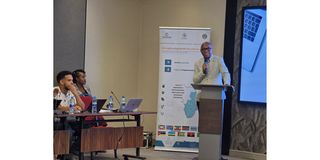
ECSA-HC Senior Medical Epidemiologist Dr Mohamed Mohamed addresses epidemiologists from nine countries across Eastern and Southern Africa during the opening of the Regional Training on Non-Communicable Diseases (NCDs), held in Dar es Salaam from August 12 to 14, 2026.
Dar es Salaam. For years, frontline health workers across Africa have been trained to spot disease outbreaks and respond to infectious threats. Now, they are being equipped with another task, identifying the warning signs of chronic diseases before they become harder and more expensive to manage.
That shift is at the centre of a regional training programme that has brought together 37 health professionals from nine African countries in Dar es Salaam to strengthen the capacity of mentors supporting frontline epidemiologists.
The participants have completed the second phase of a regional Training of Trainers (ToT) programme under the World Bank-funded Health Emergency Preparedness, Response and Resilience Programme (HEPRR-MPA) which covers 11 countries across Eastern and Southern Africa under the World Bank's Multiphase Programmatic Approach (MPA): Angola, Botswana, Burundi, Democratic Republic of the Congo (DRC), Ethiopia, Kenya, Malawi, Mozambique, Rwanda, São Tomé and Príncipe, Zambia.
The Training programme is implemented by the East, Central and Southern Africa Health Community (ECSA-HC) in collaboration with the Intergovernmental Authority on Development (IGAD).
Unlike approaches that treat non-communicable diseases as a separate health programme, the training integrates NCD surveillance into the existing Frontline Field Epidemiology Training Programme (FETP-Frontline).
This means health workers who are already working in communities can add conditions such as hypertension, diabetes, cancer and cardiovascular diseases to the health problems they routinely monitor and report.
HEPRR-MPA Project Coordinator Dr Mohamed Mohamed said the change reflects the reality facing health systems across the continent, where several health problems are now occurring at the same time.
“Health systems are dealing with infectious disease outbreaks, non-communicable diseases and injuries from road traffic accidents at the same time. This is increasing pressure on health facilities,” he said.
For Dr Mohamed, the answer is not to create another layer of health programmes, but to make better use of the workers and systems already in place.
“We can no longer focus on infectious diseases alone. We need professionals who can investigate and analyse NCD trends so that action can be taken early,” he said.
The new approach borrows from a method that health workers have traditionally used to investigate infectious disease outbreaks.
The same skills collecting information, analysing data, identifying unusual patterns and investigating possible causes can also be applied to chronic diseases.
For example, a sudden increase in hypertension cases in a particular community could prompt health officials to look more closely at possible risk factors and determine whether preventive action is needed.
Dr Mohamed said participants were introduced to environmental health risks, including exposure to toxic substances such as mercury in small-scale mining communities.
Such exposure, he said, can potentially affect communities through contaminated environments and the food chain, making surveillance important in identifying health risks early.
Tanzanian epidemiologist Loveness Urio said one of the strengths of the programme was that it avoids creating a parallel surveillance structure for NCDs.
Instead, NCD monitoring, investigation, data analysis and response are being incorporated into the existing FETP-Frontline system.
“The training enables health professionals to identify changes in disease trends early, identify risk factors and use reliable information to guide public health decisions,” Ms Urio said.
She said this would also help health workers recognise unusual clusters of cases and investigate what might be driving them.
The urgency is not only about the number of people falling sick. There is also an economic cost when chronic illness is detected late.
According to Ms Urio, NCDs can result in premature deaths, disability, reduced productivity and increased treatment costs for households and governments.
A worker who develops complications from an untreated chronic condition may spend more time away from work, while families can face additional costs caring for a sick relative.
Early detection, she said, can help reduce some of those costs by allowing health workers and patients to act before complications become severe.
“Training will not eliminate the economic burden caused by NCDs, but it can contribute to reducing it through early detection, timely response and better use of available resources,” she said.
The 37 participants will also play a role beyond the training room. As mentors, they are expected to provide technical coaching, supervise field work and support other health workers as the revised NCD-integrated curriculum is put into practice.
The wider goal is to bring NCD surveillance closer to where people live and seek care.
For health systems already dealing with outbreaks, chronic diseases and injuries at the same time, the thinking is simple, the earlier a problem is seen, the greater the chance of doing something about it before it becomes a crisis