Dodoma. The Aga Khan Foundation, in partnership with the Embassy of Ireland in Tanzania through the Tuinuke Pamoja project, will invest Sh7 billion over three years to promote gender equality and empower women by strengthening community groups across eight councils in Dodoma Region.
The beneficiaries come from Kondoa Rural, Kondoa Urban, Bahi, Chamwino, Dodoma Urban, Mpwapwa, Kongwa and Chemba councils, with a focus on women, people with disabilities, and youths.
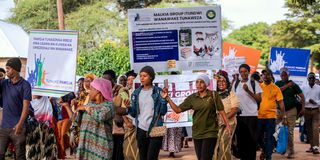
Speaking at the recent launch of the Tuinuke Pamoja project in Kondoa District, beneficiaries said the funding had significantly improved their lives.
The Tujikomboe Makamaka women’s group from Chemba District, treasurer, Ms Veronica
Banari, said the support enabled them to start vegetable gardening and acquire sewing machines for a tailoring school.
“So far, five students have enrolled for sewing training, which is offered free to girls and women who face financial barriers,” she said.
The group is committed to ensuring that women and girls in need acquire skills that foster economic empowerment, self-reliance, and reduced dependency.
Ms Banari added that the Embassy of Ireland had provided Sh27.5 million through the Aga
Khan Foundation, which helped launch multiple projects, including modern poultry farming.
“We plan to build a large poultry house for 2,000 chickens, up from our current 450,” she said.
She also highlighted a project producing sanitary pads, which are distributed to students to ensure safe menstruation, so that no girl misses school.
Before the funding, she said, the group’s efforts yielded little impact; with support and training from Tuinuke Pamoja in project management, financial management, and record keeping, they have begun achieving tangible results.
The Bahi District based Amkeni Wanawake Viziwi group chairperson, Ms Helena Banjilwa, said the group consists of three deaf women who have chosen to specialise in peanut butter production.
“Joining the group helped us overcome challenges associated with our disability, including stigma. We united to seize opportunities, including funding from the Embassy of Ireland and program implementation support from the Aga Khan Foundation,” she said.
Through the support, they received entrepreneurship training and guidance on economic, social, and developmental opportunities, including human rights, disability rights, and gender equality. “The Aga Khan Foundation has enabled us to stand on our own, and now we are confident,” Ms Banjilwa added.
Aga Khan Foundation project manager, Mr Nestory Mhando, said 21 groups from Kondoa
Urban, Kondoa Rural, and Chemba councils had benefited from capacity building and grants for project implementation.
He noted that 36 groups from Bahi, Dodoma City, and Chamwino are still in the capacity[1]building phase, while Kongwa and Mpwapwa councils will soon join the Sh7 billion project in partnership with the Embassy of Ireland.
Mr Mhando said the beneficiaries are community groups at village, ward, and sub-ward levels, as well as registered groups of people with disabilities and youths, all aiming for economic empowerment and gender equality.
Aga Khan Foundation Chief Executive Officer, Ms Atteeya Sumar, said the first half of the project had already shown positive results.
Groups have received training in entrepreneurship, financial management, business education, environmental care, and combating gender-based violence, including female genital mutilation.
She said a total of 10,969 beneficiaries were reached in Kondoa Urban, Kondoa Rural, and
Chemba councils, including 6,224 women and 4,745 men.
Deputy Permanent Secretary for Community Development, Gender, Women, and Special
Groups, Ms Felister Mdemu, urged beneficiaries to use the funds appropriately to strengthen their economic status.
“With funding support from the Embassy of Ireland, the Aga Khan Foundation is implementing this initiative for your empowerment; do not disappoint,” she said