Dar es Salaam. The long-running national debate over the language of instruction in Tanzania has returned to centre stage after celebrated writer and poet Abdilatif Abdalla called on the government to honour the legacy of Julius Nyerere by making Kiswahili the official language of teaching in schools.
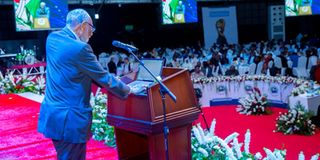
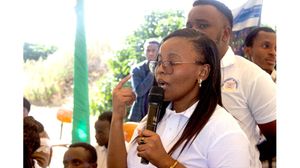
Speaking in Dar es Salaam on April 14, 2026 during the presentation of the National Mwalimu Nyerere Creative Writing Awards, Mr Abdalla said Tanzania has both the history and capacity to make the shift.
“In honour of Mwalimu Nyerere, I humbly ask the government of Tanzania to reconsider this matter. Let Kiswahili become the language of instruction in our schools. It is possible,” he said.
His remarks revive one of the most sensitive and enduring questions in Tanzanian education: should children continue to learn through English in secondary and higher education, or should the country adopt Kiswahili throughout the system?
For decades, Tanzania has used Kiswahili as the medium of instruction in primary schools, while English has largely dominated secondary schools, colleges and universities.
Critics say this transition creates a learning barrier for many students, especially those from rural and low-income backgrounds who may have little exposure to English outside the classroom.
Education experts have long argued that children learn best in a language they understand. They say language should be a bridge to knowledge, not a gatekeeper.
Mr Abdalla drew parallels with Europe’s own linguistic history. He noted that English and other European languages were once looked down upon in favour of Latin, which was considered the proper language of science, medicine and scholarship.
“People once claimed that English had no words for medicine or science and that true education could only be delivered in Latin,” he said, suggesting that languages grow through use, innovation and confidence.
His argument echoes the thinking of many African scholars and literary giants. Kenyan author Ngũgĩ wa Thiong'o famously championed African languages in education and literature, arguing that language carries culture, identity and ways of thinking.
He warned that educating African children solely through colonial languages could distance them from their realities and creative potential.
Likewise, Nyerere himself translated world classics into Kiswahili and consistently defended the language as a tool of unity, dignity and national development, making Kiswahili one of Africa’s most successful national languages.
That vision has also found space in current reforms. Under the Education and Training Policy of 2014, Edition 2023, the government reaffirmed the importance of strengthening Kiswahili while improving competence in English and other languages.
The reforms seek to raise literacy, communication skills and practical competencies, while ensuring that language supports learning outcomes rather than undermining them.
Although the policy does not abruptly remove English from the system, it has renewed momentum for wider use of Kiswahili in teaching, curriculum materials and assessment, particularly as Tanzania rolls out the improved 2023 curriculum.
About the Awards
At the awards ceremony, Permanent Secretary in the Ministry of Education, Science and Technology, Prof Carolyne Nombo, said the government had spent Sh4.2 billion on the awards up to the 2025/2026 financial year, now in their fourth season.
She said the investment covers book publishing, prizes for winners and broader support to the publishing industry.
“The government will continue creating opportunities for local writers, who are a national treasure,” she said.
The awards form part of a wider state effort to preserve Nyerere’s intellectual legacy through Kiswahili and creative writing.
Chairperson of the awards committee, Prof Penina Mlama, said this year’s competition received 260 manuscripts from across mainland Tanzania and Zanzibar, as well as from Tanzanians living abroad.
Of these, 86 were poetry collections, 53 novels, 73 children’s stories and 48 plays.
“We are pleased to see participants from 27 regions. This shows national reach and growing interest,” she said, though she noted that many submissions failed to meet required standards.
The significance of the awards goes beyond literature. Director General of the Tanzania Institute of Education, Dr Aneth Komba, said creative writing strengthens learners’ imagination, problem-solving ability, reading culture, confidence and language skills.
She added that one of the new subjects introduced in curriculum reforms is Kiswahili literature, designed to nurture student talent in poetry, short stories, novels, drama, satire and oral expression.
“These awards are a practical tool in implementing the Education and Training Policy and the improved 2023 curriculum. They increase creative reading materials in schools,” she said.
For many observers, that may be the heart of the debate. Language is not only about grammar or classroom instruction. It is about access, confidence, identity and the ability of young people to think deeply and create boldly.