Climate action ineffective without tackling gender concerns, stakeholders warn
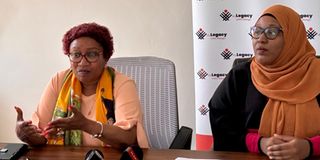
My Legacy Director Fortunata Temu (left) speaks on the impacts of climate change in Tanzania, alongside Programme Coordinator Amina Ally (right). PHOTO | COURTESY
Dar es Salaam. Stakeholders have warned that efforts to combat the effects of climate change will be less effective if they fail to address gender issues, particularly reproductive health rights and the fight against gender-based violence.
The warning comes following an assessment of climate adaptation plans in Kinondoni District covering the period 2013/14 to 2024/25, which revealed that most initiatives have focused on infrastructure, such as drainage cleaning and environmental protection, while the specific needs of women, children, and persons with disabilities have largely been overlooked.
Speaking in Dar es Salaam, Director of My Legacy, Fortunata Temu, said these groups continue to bear the heaviest burden of climate impacts, including water scarcity, increased disease outbreaks, and incidents of violence exacerbated by difficult economic and social conditions.
She noted that through the “Kesho Njema” project, the organisation assessed wards in Kinondoni and found that most climate plans do not adequately incorporate a gender perspective.
“Most people focus on environmental impacts only, but there are other consequences that directly affect women, children and persons with disabilities. Existing plans do not consider these,” said Fortunata.
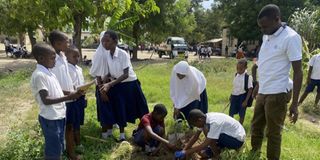
Students of Nakasangwe Primary School in Wazo, Kinondoni, plant trees as part of climate change education under the Kesho Njema project. PHOTO | COURTESY
She added that coordination between environmental, health, and gender departments remains weak. Gender-disaggregated data are insufficient, and participation by women, youth, and marginalised groups in climate decision-making is limited.
“Climate change is a cross-cutting agenda that requires a broad approach. It is essential to integrate indicators on reproductive health rights and measures to combat gender-based violence into climate strategies, starting at the community level,” she emphasised.
Fortunata also called for stronger cross-sector coordination and the allocation of gender-responsive budgets to ensure no group is left behind in climate action.
Amina Ally, Programme Coordinator for My Legacy, said that beyond the assessment, the one-year project funded by the Irish Embassy in Tanzania enabled practical implementation of climate adaptation activities.
She explained that 2,000 shade and fruit trees have been planted in 24 schools in Kinondoni to reduce heat and improve learning environments. Students also received training on tree planting and care, alongside simple irrigation techniques using recycled plastic bottles to reduce solid waste.
“In total, 775 students from 25 schools were reached through WASH clubs with dedicated climate education sessions. Participatory methods such as drama, storytelling, and art were used to build awareness about proper energy use, environmental conservation, and the link between climate change and gender issues,” said Amina.
The organisation also convened a social dialogue called ‘Knowledge Café’, bringing together community leaders, women, youth, and persons with disabilities to discuss climate challenges and solutions in their areas.
Speaking at the dialogue, Kawe resident Richard Mtanga said there could be no effective climate strategy without addressing gender issues.
“There can be no robust climate strategy if it does not tackle gender-based violence and ensure access to reproductive health services and rights. Protection and dignity must be part of climate action,” he said.