Climate change: Even the dead at risk as coastal graves vanish

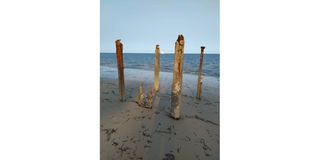
Coastal protection structures along the Pangani shoreline near Maziwe village help prevent seawater from encroaching onto land. PHOTO | THE CITIZEN REPORTER

Tanga/Pemba. On the frontlines of climate change, loss is no longer measured only in washed-away homes, ruined crops, or broken seawalls.

In Tanzania’s fragile islands and coastal belts, the crisis has reached even the resting places of the dead.

Across Panza, Madauni, and Ufunguni islands in Pemba, and along the coast of Pangani in Tanga Region, the sea is tearing open graves, exposing human remains, and forcing families to rebury their loved ones.

The waves no longer respect the boundary between land and grave. Even the dead cannot escape the impacts of climate change.

When the sea disturbs the dead

In Panza Island, residents recall the first time bones appeared on the shore.

“We saw skeletons of people buried long ago lying exposed,” said the Pemba Community Forest Management and Development Association Secretary, Mr Juma Ali Mati.

“When the tides are high, they wash away the soil. Some graves collapse, and human bones rise to the surface. We had to collect the remains and rebury them on higher ground, at least for now, where the sea has not yet reached,” he added.

In Madauni village, the situation is even more alarming as graves that once stood 200 metres inland are now submerged.

“When strong waves come, even new graves disappear. Our elders say the dead no longer have peace because the ocean has taken their space,” said Sheha of Panza Island, Mr Haji Ali Shaame.

In Ushongo village, Pangani District, Tanga Region, a villager Mr Mzee Mtoo recounts personally recovering human remains exposed by advancing waters.

“With my own hands, I once picked up a human skull. It had lines resembling braided hair. We reburied it carefully. Graves that were once on higher ground are now repeatedly uncovered by tides,” he recounted.

For communities deeply rooted in tradition, burial grounds are sacred markers of lineage, identity, and faith, and to see them destroyed is more than environmental loss; it is cultural trauma.

“These are our relatives. We believed they would rest in peace. Now, every heavy rain or storm tide brings them back to the surface,” said Mr Mtoo quietly.

From environmental loss to human rights concern

Beyond visible destruction, legal and human rights experts warn that the crisis raises deeper concerns.

International frameworks, including the International Covenant on Civil and Political Rights, guarantee communities the right to practice cultural and religious traditions, including dignified burials.

Disturbance and repeated exposure of graves due to climate-induced coastal erosion may therefore constitute a violation of cultural and religious rights, elevating the crisis from a local environmental tragedy to a broader human rights issue.

“Graves symbolise family, clan, and belief. If they disappear, it is as if we are erased from the map of history,” said Mr Shaame. “

Villages turning into an ocean

The crisis extends beyond cemeteries, as on Panza Island in Pemba, saltwater has invaded farms and homes in Ambasha and parts of Old Kojani.

“There used to be more than 3,000 houses here. Now fewer than 700 remain. People have moved to higher ground after the sea invaded,” said Sheha of Kojani, Mr Ali Hamad Bwakane.

Farmlands once rich with cassava and sweet potatoes have turned into saline plains.

“We live like strangers on our own land. The sea is slowly consuming it. We are watching our history disappear,” said a resident of Madauni, Ms Fatuma Omar.

Climate change behind the tide

Experts say these events are direct consequences of global warming and sea-level rise.

“Rising global temperatures cause sea levels to rise. Islands and coastal areas are the most vulnerable, and the pace is accelerating every year,” said the Department of Environment in Zanzibar, Dr Makame Omary Makame.

Research indicates that more than 30 percent of Zanzibar’s small islands show signs of coastal erosion, with some losing up to 20 metres of land within a decade.

The warning of Maziwe Island

Perhaps no example captures the future more starkly than Maziwe Island, once a lush coral island off Pangani. Today, it has almost entirely disappeared beneath the sea.

“We used to go there to relax. There were trees and shade. Today, there is nothing. The sea has swallowed everything. It is as if it never existed,” recalls Mzee Rashid Kombo of Pangani.

Maziwe serves as a historical warning, a glimpse of what may await other islands if urgent action is not taken.

Government efforts—a race against time

The Revolutionary Government of Zanzibar (RGZ) says it has begun mitigation efforts.

Head of the Climate Change Unit in Pemba, Mr Ali Abdi Mohamed, noted that three seawalls have been constructed, and mangroves and coastal vegetation are being planted to stabilise shorelines.

“But when we block the water in one area, it shifts to another. The football field in Panza is now flooded during high tides. It is an endless battle between land and sea,” he said.

Participatory marine conservation areas have also been introduced, but the scale of change often exceeds available financial and technical capacity.

Climate finance under scrutiny

While Tanzania receives international climate support, experts warn that much of the funding goes into planning and administration rather than tangible adaptation infrastructure.

“In vulnerable coastal areas, residents say the absence of large-scale protective infrastructure raises questions about whether climate funds are reaching frontline communities,” said one community member.

Laws on paper, waves in reality

Weak enforcement remains a major obstacle. The Environmental Management Act of 2004 and the Local Government Act of 1982 provide mandates to protect coastal zones, but implementation is limited.

“If these laws were enforced properly, graves would not be collapsing. We would have buffer zones, stronger mangrove belts, and better community awareness,” said Dr Makame.

Communities fighting back

Faced with slow institutional responses, residents plant mangroves each rainy season, construct small stone barriers, and carefully reinter exposed bones.

“We know it is not enough. But doing nothing is worse. This is our land and our history,” said Mr Mati.

Poverty complicates the effort as many depend on the sea for income, sometimes cutting mangroves for lime burning, which worsens erosion.

A warning

From Pangani to Panza, the rhythm of the waves tells one story: the sea is advancing.

“A grave that is 100 metres from the shore today can be at the water’s edge within five years,” says Mr Shaame.

Experts warn that without stronger enforcement, targeted climate financing, and recognition of the crisis as both an environmental and human rights issue, the damage will deepen.

“If we allow this to continue, it will not only be the dead who lose their peace. The living will lose their land to stand on,” warns Dr Makame.