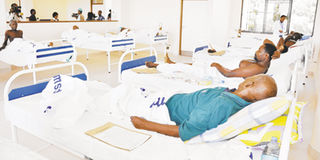
A less congested ward at Muhimbili National Hospital where new beds were recently supplied on the orders of President Magufuli.
PHOTO | FILE
What you need to know:
Many would shudder at the thought of spending a night admitted to the country’s biggest referral hospital. Poor management was hugely blamed for the problems at the 1,500-bed health institution.
Dar es Salaam. From doctor strikes, overcrowding and inefficiency to a general lack of key equipment, the problems that were slowly turning Muhimbili National Hospital (MNH) into a deathbed seemed insurmountable.
Many would shudder at the thought of spending a night admitted to the country’s biggest referral hospital. Poor management was hugely blamed for the problems at the 1,500-bed health institution.
The outcry from patients and stakeholders over the slow but sure crumbling of the health system at MNH had been long, and yet nothing seemed to be moving authorities to act.
Being the epitome of the public health system, the sorry state of affairs at the hospital had forced many to lose hope and trust in State-run health facilities.
But that could change.
A surprise visit to the hospital by President John Magufuli during his first days at State House at the end of last year set the institution on a new path of recovery.
The hospital’s director became one of the first executives to be booted out over inefficiency by President Magufuli in his first days in office.
The President appointed a new management led by Prof Lawrence Museru to spearhead reforms at the country’s biggest hospital. Admittedly, that will not be a walk through the park.
MNH needs at least Sh48 billion each year to sort out its mess. Management says it has been running on a constrained budget of less than 10 per cent of its needs.
But spot checks by The Citizen over the past few weeks give the impression of change. The usual spectacle of patients sleeping on the floor in corridors of the Sewahaji Ward are now a thing of the past.
Frequent breakdowns
The frequent breakdown of key diagnostic apparatuses—such as the CT-scan and MRI may also end soon as the management is fixing new equipment that matches the hospital’s bed capacity and status.
For many years, patients who needed to undergo CT scans and MRI testing had to pay exorbitant fees for the services at private hospitals.
During his visit, President Magufuli expressed concern over the laxity of the management to fix the machines, which had not been working for three months. He gave the management two weeks to get the machines working again.
Senior government officials, including the Chief Secretary, made follow-ups on the matter.
In response, a brand new CT-scan apparatus worth about Sh3.4 billion, was recently installed. The Siemens brand has the capacity to produce 128 photographic films and serve more patients than the previous machine, which made only six films and diagnosed only a few patients.
Salary arrears paid
Dr Christopher Ruhinda, a dental surgeon at MNH, is one of the many staff members who had been owed by the hospital.
“I had almost given up on the arrears. For over 10 months, I had not been paid. But now, every penny has been settled,” he said.
The Citizen has also established that the hospital’s top officials, in collaboration with the Ministry of Health and Social Welfare, have embarked on a fresh drive to motivate the hospital staff in an effort to improve performance.
“Motivating our staff is part of the main hospital’s short-term and long-term goals,’’ confirmed the hospital’s head, Prof Museru.
However, some of the doctors seem not to forget the past problems so easily. They are quick to express their disappointment, questioning why “it took so long” for the hospital and the government to address shortage of key diagnostic machines.
They have also not forgotten case of patients sleeping on the floor, despite their numerous pleas in the past.
A staff member who spoke to The Citizen recently said: “We complained about this matter four years ago during a strike by doctors, but nobody cared to address the problem of patients sleeping on the floor.”
Another doctor, a surgery specialist said there had been culture of laxity at the hospital, which posed a serious risk to patients.
Prof Museru admits that the major changes taking place at the moment were a direct response to the President’s initiatives.
The money saved from the reduced budget of a cocktail party that was organised for his inaugural National Assembly address in Dodoma bought 300 hospitals beds.
But challenges persist, as the President witnessed during his surprise visit to the hospital on Wednesday. In the maternity, Ward, space is till at a premium, and for pregnant women, privacy is a far-fetched dream.
“Despite the additional supply of beds, the hospital is still congested because of unnecessary referral of patients from lower level health facilities,” says Professor Museru.
“We are trying to speed up our diagnostic process to avoid keeping patients here for too long. But our appeal is for the problems at regional hospitals to be fixed to help us reduce the number of patients referred to this hospital,’’ he told The Citizen in an interview recently.
Granted, the acting director is man with a lot on his hands, one more of his biggest headaches at the moment is issue of interns. For years, Muhimbili has been the epicentre of doctors’ strikes that spread across the country. Delayed payment of salaries often spark the industrial actions that threaten to paralyse the health system.
“We are handling their matters promptly. But on the issue of accommodation, they will have to bear with us for a little longer because we do not have the capacity to accommodate all of them at the moment,” said the hospital boss.
Not only that. MNH, like the rest of public health facilities in the country, is facing critical shortages of essential medicines and medical supplies.
The establishment of a new Community Pharmacy by the Medical Stores Department at the hospital’s premises has helped to improve services.
The Citizen also interviewed some relatives of patients who had gone to the MSD pharmacy at the institution to buy medicines. They revealed that low prices were the pull factor. Most could not afford medicines at private pharmacies.
The Health ministry recently announced plans to set up similar community pharmacies at major hospitals countrywide. The MNH was the pioneering institution.
The success of the reform programmes at MNH are critical. It will prove that the hands-on approach by President Magufuli is what may needed to address the social services ills affecting the country.