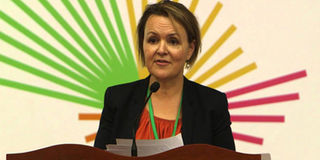
The laboratory, according to World Bank’s Country Director Bella Bird, will serve in mapping space and reserve for collected information on disaster-prone areas.
Ms Bird said this during the official launch of the Ramani Huria Pro-gramme.
Dar es Salaam. Tanzania is considered one of the countries most prone to floods, prompting an urgent call for a spatial data laboratory.
The laboratory, according to World Bank’s Country Director Bella Bird, will serve in mapping space and reserve for collected information on disaster-prone areas.
Ms Bird said this during the official launch of the Ramani Huria Pro-gramme.
She said in response to vulnerability of cities to climate-related challenges, the Tanzania Urban Resilience Programme (TURP), a partnership between the government and UK’s Department for International Development (DFID) and the World Bank, is helping to develop core tools, policies, and actions of modern disaster risk management practices.
“Recently, in 2009, 2011, and 2013, flooding in Dar es Salaam caused loss of lives and injuries to several people besides having a severe impact on infrastructure. This needs risk management practices, which include risk identification, risk reduction, and disaster preparedness and emergency management,” she said.
She said communities, which are at the greatest risk, are those based in informal settlements surrounding the Msimbazi Valley even though the effects of flooding are felt by all city residents.
According to her, it is estimated that floods cost the city approximately $47 million annually at the Msimbazi basin alone.
In view of this, she said that the Ramani Huria project will help deliver the three pillars through mapping risk-prone are-as, building capacity for community-led risk reduction as well as flood response activities and equipping students and city residents with skills to improve resilience throughout Dar es Salaam.
Since 2015, Ramani Huria has mapped 1.3 million residents of the flood prone areas of Dar es Salaam, trained over 450 mappers and, in collaboration with the Red Cross, established 10 disaster prevention teams with 100 community risk responders.
Beyond building resilience - preparing communities and mitigating disaster risks - Ramani Huria’s expansion will transfer skills in modern tools and methods to support sustainable urbanisation.
For his part, the Vice Chancellor of the Ardhi University, Prof Evaristo Liwa, said Ramani Huria is a collaboration initiative of the Ardhi University and the World Bank to build skills and capacity of students to map areas at risk of natural hazards. He said the project started in 2011 as a pilot study in Dar es Salaam during the devastating floods.
“Our students volunteered to digitise the impacts of the floods and the scope has expanded from city mapping to flood disaster risk resilience and also availed opportunity to handle disaster in Bukoba,” he said.