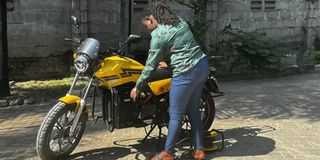
Kigoma. Inside the small laboratory at Migongo Health Centre in Buhigwe District, Kigoma Region, Mr Frank Marwa works confidently, arranging test samples and recording results.
Outside, an electric motorcycle powered by solar panels on the health centre’s roof waits by the door, serving as his reliable link to town.
With it, Mr Marwa, head of the laboratory, can rush to town anytime to collect vaccines or submit reports to the Buhigwe Medical Office, tasks that once involved long waits or costly transport.
“Before, we used to spend about Sh20,000 to Sh30,000 a day on petrol-powered motorcycles. Now, the cost has dropped so much that we can save and serve more people,” Mr Marwa told The Citizen during a recent interview.
The motorcycle is also used to transport patients for referrals and emergencies from the facility in Kilelema Ward, “To us, this is a transformation. It’s faster, cleaner, and cheaper.”
The Africa E-Mobility Report 2025 by the Africa E‑Mobility Alliance (AfEMA) shows that Tanzania has around 10,000 electric vehicles on the road, mostly two- and three-wheelers.
Mr Marwa is part of a transformation unfolding on Tanzania’s roads as electric motorcycles steadily enter everyday use.
Commonly promoted as a tool for reducing carbon emissions, their impact extends beyond environmental benefits.
The Global Emerging Market Overview for Electric Two- and Three-Wheelers report (2024) by the United Nations Environment Programme notes that shifting to these vehicles could reduce carbon dioxide and other greenhouse gas emissions by 500–600 megatonnes annually.
That is equivalent to removing 170–200 million petrol-powered cars from the road, about four times the number of cars in Germany in 2024.
Electric motorcycles for livelihoods
In Tanzania, where motorcycles underpin mobility in both urban and rural areas, the shift to electric power is reshaping not only health services but also the quality of life, particularly among youth.
Electric motorcycle owner and a Dar es Salaam resident, Mr Julius Michael, said the vehicles have helped lower transport costs, increase mobility, and support his financial stability.
“Electric motorcycles are very helpful because you don’t go to the petrol station; you just charge, which saves a lot on living costs,” he explained.
He previously spent Sh9,000 per day on transport, but after switching to an electric motorcycle, his costs dropped to below Sh2,000.
Since adopting the technology in January 2024, the savings have allowed him to set aside money for personal goals, showing how electric mobility can ease urban transport challenges and improve quality of life.
However, he noted that stakeholders must address battery availability when motorcycles run out of power, stressing that reliable and accessible accessories are essential for long-term sustainability.
The technology behind these motorcycles is designed with riders like Michael in mind.
Ekoglobe Fleet Operations Officer, Mr Clinton Elias, said electric motorcycles have fewer moving parts, meaning less to repair, “No engine overheating and much lower maintenance costs.”
According to Mr Elias, the benefits go beyond convenience, noting that less time is spent fixing a bike means more time earning, which transforms livelihoods.
“It consumes very little energy. For example, if you charge the battery for Sh1,800, you can travel 100 kilometres, something you cannot achieve with a conventional petrol motorcycle,” he adds, noting that the features make electric motorcycles practical for a full day’s work in cities like Dar es Salaam.
Ekoglobe supplies electric motorcycles in Dar es Salaam, Arusha, Dodoma, Mwanza, and Mbeya, and plans to expand to other regions to support green employment among youth.
Affordability remains key
Despite growing interest, affordability remains a major challenge. The cost of electric motorcycles is high, and access to financing is critical.
Some financial institutions have introduced loan products tailored for electric two- and three-wheelers.
“These motorcycles are expensive to own, and many riders cannot pay the full cost upfront,” said DEEM Finance Compliance and Relationship Manager Sewa Msasa.
“Through our lease-to-own model, riders can make gradual payments while earning a living in these green jobs,” she added.
Ms Msasa explained that the goal is to support technological adoption in the transport sector, noting that ownership contributes to a modern, positive transformation of the industry.
Market reports show that an electric motorcycle costs between Sh3.8 million and Sh6.5 million, but riders save enough on fuel and maintenance to recoup the difference within a year.
Policy reforms are key to adoption
Greenfoot co-founder Johnson Jaka said the use of locally available spare parts, alongside supportive policy reforms, is critical to increasing electric motorcycle adoption in Tanzania.
“Despite their benefits, there is still no significant policy change, and electric motorcycles are treated the same as conventional ones,” he noted, adding that his company accelerates the adoption of clean transport technologies across the country.
He added that relying on locally generated electricity instead of imported fuel will strengthen national energy independence, while tax exemptions and import duty relief could further accelerate uptake.
Electric motorcycles serve as a practical catalyst for implementing Tanzania’s Development Vision 2050 and the National Energy Efficiency Strategy (2024–2034), which emphasise environmental sustainability, economic empowerment, energy security and modern transport through zero-emission, low-cost mobility.