Uzbekistan. Global efforts to address climate change, biodiversity loss and environmental degradation gained significant momentum this week.
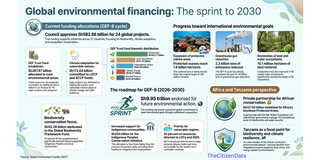
The Global Environment Facility (GEF) endorsed a $3.9 billion (Sh9.95 trillion) replenishment package and approved $232.5 million (Sh592.88 billion) for new environmental projects. Leaders described the move as a crucial step in the “final sprint” toward meeting global environmental targets by 2030.
The decisions were made at the 71st GEF Council meeting in Samarkand city in Uzbekistan ahead of the Eighth GEF Assembly, which brought together nearly 2,000 participants from governments, civil society, development agencies and the private sector.
For Tanzania, a major GEF recipient in East Africa, the new funding cycle offers opportunities for environmental investment, though communities still face barriers to accessing funds.
The GEF Council approved 24 projects across 22 countries, including $144.3 million (Sh367.97 billion) from the GEF Trust Fund, $67.7 million (Sh172.64 billion) through the Least Developed Countries Fund and Special Climate Change Fund, and $20.5 million (Sh52.02 billion) from the Global Biodiversity Framework Fund.
Beyond the immediate approvals, representatives of 186 participating countries endorsed the programming framework for GEF-9, a $3.9 billion replenishment covering the period from July 2026 to June 2030.
Speaking during a press briefing, GEF Interim Chief Executive Officer Claude Gascon described the replenishment as a strong signal of continued global commitment to multilateral environmental action despite growing fiscal pressures in many donor countries.
"The GEF-9 replenishment shows a very clear and strong signal that multilateral collaboration still matters," he said. "Donor countries pledged an initial $3.9 billion to help developing countries accelerate progress toward the 2030 environmental goals."
Mr Gascon said the new cycle will focus on integrated environmental programmes, blended finance, stronger private sector participation and greater support for vulnerable countries and local communities. The package directs 35 percent of resources to Least Developed Countries and Small Island Developing States, while 20 percent is earmarked for Indigenous Peoples and local communities.
For Tanzania, environmental advocates welcomed the stronger focus on local participation but cautioned that many grassroots organisations still struggle to access available funding.
Speaking to The Citizen, Mr Tumaini Marijani, Regional Focal Point for the GEF Civil Society Organisation Network, said many village groups and local NGOs remain unaware that grants exist through programmes such as the GEF Small Grants Programme.
"Even when they are aware, the application procedures are often too technical and difficult for grassroots organisations," he said, adding that funding calls should be translated into Kiswahili and disseminated through district councils, ward offices and community organisations.
Mr Marijani also urged government institutions to strengthen awareness and capacity-building programmes for youth, women and community groups, arguing that local actors need greater exposure to funding opportunities and stronger links to international environmental platforms.
GEF leaders say such concerns are being addressed through reforms designed to make financing easier and faster to access. Mr Gascon said GEF-9 includes structural changes intended to make the institution "faster, simpler and more accountable," while accelerating project approvals and reducing administrative complexity.
"We know that countries need more resources, faster and with less complexity," he said.
The reforms also place greater emphasis on aligning environmental investments with national priorities. Chizuru Aoki, Head of the GEF Division of Multilateral Environmental Agreements and Funds, said guidance from international environmental conventions has increasingly stressed integration and policy coherence.
She noted that, “countries are now being encouraged to design projects that simultaneously address climate adaptation, biodiversity conservation and sustainable development priorities, while ensuring measurable impacts are tracked throughout project implementation”.
Another major feature of the new funding cycle is the expanded use of blended finance, which aims to attract private investment alongside public environmental funding.
Dr Fred Boltz, Head of Programming at the GEF, said grant financing can play a critical role in reducing investment risks and unlocking larger pools of capital.
"Public funding is absolutely necessary to conserve and manage the global environment, but it is not sufficient," he said.
"Blended finance enables us to engage the private sector, support innovation and multiply the investments available for countries."
According to GEF figures, blended finance operations under the current cycle have generated more than $18 in co-financing for every dollar invested by the facility.
This story was produced as part of a reporting fellowship to the Eighth GEF Assembly supported by Internews’ Earth Journalism Network.