Government acquires 16 percent stake in graphite project
Minerals Minister Anthony Mavunde (second left) shakes hands with Lindi Jumbo Director Andrew Cunningham after the signing of agreements between the Tanzanian government and Lindi Jumbo Limited on the Stateís participation in the Lindi Jumbo Graphite Project through Ndovu Graphite Limited in Ruangwa District, Lindi Region, at the weekend. With them are a representative from the office of the Treasury Registrar, Dr Emmanuel Luvanda (right), Gemcorp representative William Binedell (second right) and Lindi Jumbo Legal Adviser and Company Secretary Ephraim Mrawa. PHOTO | COURTESY
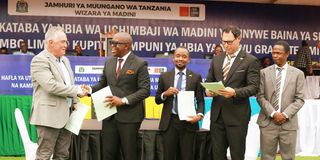
The stake will be held through a joint venture company, Ndovu Graphite Limited, while Lindi Jumbo Limited will retain the remaining 84 percent
Lindi. The government has acquired a 16 percent non-dilutable free carried interest in the Lindi Jumbo Graphite Project, strengthening state participation in one of Tanzania’s strategic mineral investments as required under the country’s mining laws.
The stake, formalised through agreements signed between the government and Lindi Jumbo Limited in Ruangwa District, will be held through a joint venture company, Ndovu Graphite Limited. Lindi Jumbo Limited will retain the remaining 84 percent.
The acquisition is significant because Tanzania’s mining legislation requires the government to hold a minimum free carried interest in large-scale mining projects, enabling citizens to benefit directly from the exploitation of natural resources through dividends, oversight and participation in key decisions.
Speaking during the signing ceremony, Minerals minister Anthony Mavunde said the agreement reflected the government’s commitment to ensuring Tanzanians receive a fair share of benefits from the country’s mineral wealth while maintaining an attractive investment environment.
“The government continues to strengthen its participation in strategic mining projects while providing investors with a predictable and stable business environment,” he said.
The project comes at a time when global demand for graphite is rising due to its use in electric vehicle batteries, energy storage systems and other clean energy technologies. Tanzania is seeking to position itself as a key supplier of critical minerals required for the global energy transition.
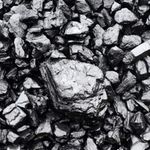
According to Mr Mavunde, the Lindi Jumbo deposit ranks among the world’s highest-grade graphite projects, with average ore reserves of 17.9 percent Total Graphitic Carbon (TGC). The mine is expected to produce about 40,000 tonnes of graphite annually over an estimated 24-year lifespan.
He said the government’s long-term objective is to encourage value addition and industrialisation by attracting investments in mineral processing and downstream industries linked to strategic minerals.
Lindi Jumbo director Andrew Cunningham said the project has evolved from exploration activities that began in 2015 into a producing mine serving international markets.
He said the operation processed nearly 170,000 dry tonnes of ore in 2025 and produced 16,421 tonnes of graphite concentrate graded between 94 and 96 percent TGC.
Confirmed sales orders exceeded 27,800 tonnes during the same period.
Mr Cunningham said the company spent Sh57.5 billion on local suppliers between 2024 and 2025, with 91 percent of procurement directed to Tanzanian businesses. The company also contributed more than Sh11.3 billion in royalties, taxes and other statutory payments.
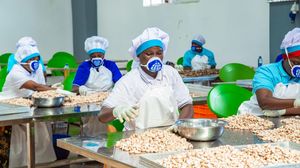
The project and its contractors employ 280 workers, more than 95 percent of whom are Tanzanians, while over half come from communities surrounding the mine.
Presenting findings from the project’s feasibility study, Treasury Registrar representative Emmanuel Luvanda said development costs were estimated at $27.8 million.
He said government revenue from royalties, taxes, fees and dividends over the mine’s projected life is expected to reach about $233 million, including an estimated $41.8 million in dividend payments arising from the state’s shareholding.
The project’s total production value over the 24-year period is estimated at about $816 million.