How government plans to bolster growth, investment in line with Dira 2050
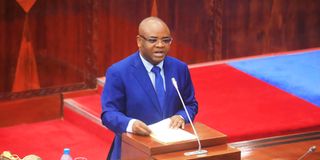
The Minister of State in the President’s Office (Planning and Investment), Prof Kitila Mkumbo, who presented his docket’s budget for 2026/27 in Parliament in Dodoma PHOTO | FILE
Tanzania has recorded rising foreign direct investment, increasing from $1.34 billion in 2023 to $1.72 billion in 2024. FDI has grown from $944 million in 2020
Dar es Salaam. Tanzania is advancing an investment-led growth strategy as it begins implementing its long-term development blueprint, Dira 2050, with the government outlining reforms aimed at unlocking capital, strengthening institutions and improving the business environment.
Presenting a Sh144.9 billion budget for the Office of the President (Planning and Investment) in Parliament on April 16, 2026, Minister Prof Kitila Mkumbo said the country’s development strategy places investment, particularly from the private sector, at the centre of economic growth.
“Our focus is to ensure that investment becomes the main driver of economic transformation in line with Dira 2050,” he said.
Dira 2050, launched in July 2025, is being implemented through the Long-Term Perspective Plan (2026/27–2050/51) and the Fourth Five-Year Development Plan (FYDP IV).
Prof Mkumbo said government efforts are focused on strengthening private sector participation in planning and implementation of development programmes.
He said consultations with stakeholders are ongoing to identify constraints affecting the business and investment environment.
Tanzania has recorded rising foreign direct investment, increasing from $1.34 billion in 2023 to $1.72 billion in 2024. FDI has grown from $944 million in 2020, reflecting what the minister described as gradual improvement in the investment climate.
Key sectors attracting investment include manufacturing, mining, finance and ICT.
The government is finalising a National Investment Policy for 2026 and a National Investment Strategy for 2026–2031.
The policy will focus on improving coordination of incentives, ensuring availability of serviced land, strengthening value chain participation and promoting technology transfer.
It will also expand financing through public-private partnerships, capital markets and diaspora bonds.
Prof Mkumbo said the government is also strengthening bilateral investment treaties to improve investor protection and reduce risks.
Special Economic Zones (SEZs) are being prioritised, with areas such as Bagamoyo, Nala in Dodoma and Kwala in Kibaha targeted for industrial investment.
By March 2026, SEZ projects worth $331.5 million had been registered, expected to create more than 11,700 jobs and generate about $885 million in exports.
The government is also preparing a Business Facilitation Law and introducing performance monitoring systems for regional administrations to improve investment attraction.
A One Stop Facilitation Centre is being strengthened to improve investor services.
Digital systems are also being introduced to improve planning and project monitoring through the National Development Plans and Project Management Information System (NPMIS).
Prof Mkumbo said the reforms aim not only to increase investment volumes but also to ensure inclusive and sustainable growth outcomes.
He said Tanzania expects that the reforms under Dira 2050 will support a more competitive and investment-driven economy.