How youth can lead the shift to sustainable food systems
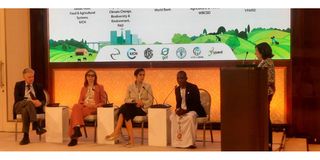
From left: Peter Goodman, Programme Lead WB - FOLUR Initiative; Piedad Martin, FAO Deputy Director for Climate Change, Biodiversity and Environment; Emeline Ellus, Senior Director for Agriculture and Food at the WBCSD; and Tadeo Ajuna, Programme Coordinator at YPARD, participate in a panel discussion on sustainable food systems in Samarkand, Uzbekistan. PHOTO|HALILI LETEA
Uzbekistan. When Tadeo Ajuna speaks about agriculture, he does not sound like someone who entered farming by chance. The Ugandan youth leader and farmer says agriculture shaped his life from childhood, paid his school fees and ultimately influenced his career path.
“I was born by farmers. I grew up farming and my education was paid for through farming,” said Mr Ajuna, Programme Coordinator at Young Professionals for Agricultural Development (YPARD), a global youth network operating in more than 62 countries.
Mr Ajuna told participants at a side event on Transforming food systems through regenerative landscape at the ongoing Eighth Global Environment Facility Assembly (GEF-8) in Samarkand, Uzbekistan that young people should view agriculture as a serious investment opportunity rather than a last resort.
“The best thing I can always say is invest wisely. Do research before you invest. Do something you are passionate about. Agriculture needs patience and passion,” he said.
His journey is becoming an inspiration to many young people seeking employment and entrepreneurship opportunities in a sector that remains the backbone of livelihoods across much of Africa.
Yet despite the opportunities, Mr Ajuna acknowledged that young farmers face significant barriers. Access to land, finance, markets and knowledge remains limited, particularly for those interested in regenerative agriculture, an approach that seeks to restore soils and ecosystems while maintaining production. He argued that many young farmers lack incentives to adopt sustainable farming practices that often require time before yielding returns.
“Knowledge is a big gap,” he said, noting that many young people are unaware of available training programmes, research resources and agricultural initiatives that could help them succeed.
The concerns raised by Mr Ajuna were echoed by global experts who warned that transforming agriculture will require more than increasing production.
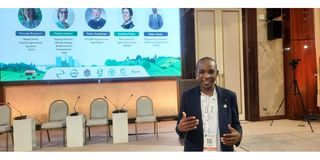
Tadeo Ajuna, Programme Coordinator at Young Professionals for Agricultural Development (YPARD), shares his experiences and calls for greater youth involvement in designing agricultural and environmental solutions during a global food systems dialogue. PHOTO|HALILI LETEA
Thematic Lead for Food Systems and Land Use at the Global Environment Facility (GEF), Mr Peter Umunay said food systems have become a major driver of environmental degradation worldwide.
According to data presented at the forum, food production occupies about 37 percent of global land, contributes 35 percent of greenhouse gas emissions, accounts for 70 percent of biodiversity loss, 80 percent of global deforestation and 50 percent of freshwater withdrawals.
“The food system has provided a lot of wealth, but at the same time it has come at the expense of natural resources,” Mr Umunay said.
He argued that governments, development agencies, farmers and the private sector must work together to transform food systems from production through to consumption.
For the United Nations Food and Agriculture Organization (FAO), the solution lies in ensuring that agricultural programmes are designed around the realities of farmers rather than assumptions made in boardrooms.
FAO’s Deputy Director for Climate Change, Biodiversity and Environment, Piedad Martin said development projects often fail when they overlook the needs of the people they are intended to support. Drawing lessons from FAO projects, she said inclusion must be built into project design from the beginning.
“We have analyzed more than 40 projects and found that when women are involved from the project design stage, environmental results last longer,” she said.
Meanwhile, Peter Goodman, Programme Lead for the World Bank-supported Food Systems, Land Use and Restoration (FOLUR) initiative, stressed the importance of combining public and private investment to support sustainable agriculture.
He said, “agricultural transformation cannot be achieved through isolated farm-level interventions alone but requires broader landscape approaches involving governments, communities and investors”.
Experts also pointed to the need for incentives that reward farmers for protecting biodiversity and ecosystems, better measurement systems for environmental outcomes and stronger coordination among institutions.
For Mr Ajuna, however, one message stands above all others: young people must not merely be counted as beneficiaries in agricultural projects but should help design the solutions themselves.
“Let’s have young people come and co-create these projects,” he said. “We should not only report numbers. We should ask how those engagements translate into action.”
As governments and international organisations search for ways to build resilient food systems, the experience of young farmers such as Tadeo Ajuna suggests that the future of agriculture may depend as much on empowering people as on funding programmes.
This story was produced as part of a reporting fellowship to the Eighth GEF Assembly supported by Internews’ Earth Journalism Network.