Italy strengthens education and science ties with Tanzania as Catholic university launches Science Park

Italian Ambassador to Tanzania, Mr Giuseppe Coppola

Iringa.  Italy has reaffirmed its long-standing commitment to advancing cooperation with Tanzania in education, science and culture, as the Italian Ambassador to Tanzania, Mr Giuseppe Coppola, visited Ruaha Catholic University (RUCU) ahead of the foundation stone–laying ceremony for the RUCU Science Park and the launch of the International Cultural and Education Project.

The ceremony, held on Thursday, January 22, 2026, at the RUCU Science Park premises, drew senior government officials, diplomats, academics, development partners and members of the public.
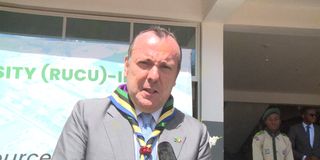
Speaking in Iringa, Ambassador Coppola encouraged young people to take full advantage of the Science Park once completed, noting that it would open doors to learning, innovation and modern scientific services.

“Italy has worked with Iringa and Tanzania for many years, particularly in the education sector. Our cooperation spans more than a century, including the contribution of the Consolata Missionary Sisters and other Italian institutions,” he said.

As part of his visit, the ambassador paid a courtesy call on Iringa Regional Commissioner Mr Kheri James, where they discussed the historical ties between Italy and Tanzania and explored opportunities to deepen collaboration in education, culture and development initiatives.

Ambassador Coppola highlighted the historical presence of Italians in Iringa and their contribution to social, religious and educational development through missionary work and community institutions.

Welcoming the ambassador, Mr James commended Italy’s continued support, noting that partnerships with foreign diplomatic missions play a key role in accelerating regional and national development.

On behalf of RUCU management, Deputy Vice-Chancellor Sr Prof Chrispina Lekule said the Science Park is envisioned as a centre of excellence for scientific research, innovation, technology transfer and entrepreneurship.

“The Science Park will provide modern laboratories, research facilities and platforms for collaboration with industry and international institutions. It will strengthen applied research in agriculture, health sciences, environmental studies and technology,” she said.

The multi-storey facility will house a specialised polyclinic, advanced laboratories for pharmaceutical sciences, medical laboratory sciences, environmental health and clinical medicine, as well as lecture halls, offices and a fully equipped auditorium.

RUCU noted that more than 70 per cent of the project’s funding has been contributed by Italian institutions, including the Bishops’ Conference of Italy, Caritas Antoniana and the Tovini Foundation, describing the support as an investment in Tanzania’s future scientists and professionals.

In addition to the Science Park, Ambassador Coppola officiated the launch of the International Cultural and Education Project, which aims to promote cross-cultural learning, academic exchange and joint research between Tanzanian and Italian institutions.

The initiative is expected to create opportunities for student and staff exchange programmes, joint degree courses, language and cultural studies, as well as collaborative research in both science and the humanities.

RUCU said the project builds on existing cooperation programmes, including Erasmus Plus and other Italy–Africa academic partnerships, which have already benefited staff and students through training and research exchanges.

University leaders described the Science Park and the international project as key milestones that will strengthen RUCU’s contribution to national development, innovation, and global academic collaboration.