The planned Great Ruaha Restoration Campaign is being set up with the cross-sector coordination objective closely in mind. PHOTO|FILE
What you need to know:
The challenge facing the Ruaha is illustrative of the rationale for the establishment of the 2030 Water Resources Group (WRG) Tanzania Partnership. We bring together stakeholders impacted by water stress, from across the public sector, private sector and civil society, to find collective solutions that are essential for the management of common resources such as water.
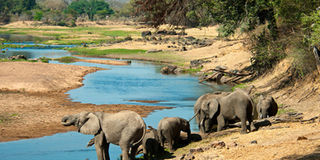
Dar es Salaam. It is a testament to the wealth of Tanzania’s environment riches that a national park of 20,000 square kilometers – half the size of the Netherlands– and home to 10,000 elephants, can remain relatively unknown outside of the region. This is the case with the Ruaha National Park.
In fact, even fewer overseas visitors would have heard of the Ruaha were it not for the fact that the Greater Ruaha river, the lifeblood of the park, has been drying up. Historically, this 300-mile river would consistently flow year round, but in 1993 the river dried up for the first time for three weeks. By 1999 this had reached three months, and by 2013 dry spells were even being reported even during the wet season.
The reasons for this trend are familiar. Rapid population growth has led to dramatic increases in demand for agricultural land with consequent impacts on water in the basin, especially for irrigation. A particular challenge in the Ruaha is the suitability of the flood plains for rice, a high-demand crop usually grown via water-intensive flood irrigation methods, with inefficient traditional water abstraction and conveyance systems.
The challenge facing the Ruaha is illustrative of the rationale for the establishment of the 2030 Water Resources Group (WRG) Tanzania Partnership. We bring together stakeholders impacted by water stress, from across the public sector, private sector and civil society, to find collective solutions that are essential for the management of common resources such as water.
So what are some solutions to this challenge? This is a question on the minds of a group of stakeholders who are coming together to establish a Great Ruaha Restoration Campaign under the 2030 WRG Tanzania Partnership. Broadly, potential solutions fall into three categories:
Increasing water productivity in agriculture
More people equals more demand for food. But the water we need to grow that food is finite. So we need to grow more with less, or generate “more crop per drop”. In many cases, as in the Ruaha, the use of more productive irrigation methods (such as drip or sprinkler systems) as well as other water-maximizing farming practices can increase agricultural productivity while reducing the amount of water that needs to be abstracted, thereby allowing the farmer to grow more with less.
This inevitably leads to the question of how to finance “modern” irrigation technologies. These systems may be more productive, but are also more capital intensive; a big challenge for cash-strapped smallholder farmers. In fact, this is another challenge we are tackling through the 2030 WRG Tanzania Partnership, with the aim to establish new financing mechanisms for efficient irrigation, in collaboration with the National Irrigation Commission and the Financial Services Deepening Trust.
Dealing with trade offs
While water productivity is often the easiest starting point, water scarcity may ultimately require harder decisions to be made. For example, it cannot make sense to operate hydropower plants on the Ruaha river below capacity on account of lower value abstraction of water upstream for irrigation. Likewise, increasing irrigation productivity may not solve the environmental challenge if “savings” are simply used to expand further land under irrigation.
The challenge is that water allocations are motivated by cultural and political, as well as economic, considerations. Getting the balance right requires some level of “refereeing” between sectors – to ensure, in this case, that the interests of the energy, agriculture and tourism sectors collectively represent the best outcome for Tanzania. The planned Great Ruaha Restoration Campaign is being set up with this cross-sector coordination objective closely in mind.
It should also be noted that effective regulation is a pre-condition for effective allocation decisions. If no one is monitoring or enforcing water abstractions in the first place, then discussions around allocations across sectors and water using groups can only go so far. Hence, as in the case of the Ruaha, strengthening monitoring and regulation of permits is going to be a crucial part of solving the challenge.
Infrastructure solutions
Another category of solutions lie in infrastructure. Recent plans for the Rufiji basin, within which the Ruaha lies, strongly recommend increasing irrigation efficiency, but also the construction of infrastructure to allow for large scale storage of water and hence regulation of dry season flows. This is certainly an important part of the puzzle.
Raising large scale public finance for such projects, however, takes time. In the meantime, research by the 2030 WRG Tanzania partnership shows demand side solutions can often offer the best returns.
The 2030 WRG Tanzania Partnership is open to all interested partners. To get involved or for more information, contact: [email protected] and visit www.2030wrg.com
Davies is Africa Lead, Sigalla is Tanzania Country representative and Ndikumwami is Tanzania’s programme coordinator at the 2030 WRG.