LHRC urges government to follow due process before suspending media outlets
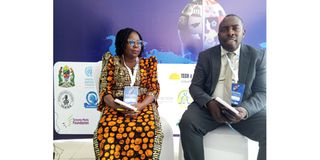
Legal and Human Rights Centre (LHRC) Executive Director, Dr Anna Henga (left), poses for a photo with the chairman of the Journalists and Media Workers Union of Tanzania (JOWUTA), Mr Mussa Juma, during the 2026 World Press Freedom Day celebrations held in Arusha on Wednesday, April 29, 2026. PHOTO | BERTHA ISMAIL
Arusha. The Legal and Human Rights Centre (LHRC) has called on the government to adhere to media and broadcasting laws before shutting down media outlets or taking disciplinary action against journalists.
LHRC warned that arbitrary suspensions undermine press freedom and weaken democracy in the country.
Speaking in Arusha on Wednesday, April 29, 2026, during this year's World Press Freedom Day commemorations, LHRC executive director, Dr Anna Henga, said any action against journalists or media organisations must follow legal procedures, including fair hearings, rather than immediate bans or suspensions imposed without legal due process.
This year’s global commemoration was held under the theme: “Shaping a Future at Peace: Promoting Press Freedom for Human Rights, Development and Security.”
Dr Henga said that while journalists and media houses are expected to operate within the law, authorities must also respect legal frameworks when addressing alleged violations.
“The law is clear. If a journalist or media outlet is accused of wrongdoing, proper legal steps must be followed, including the right to be heard in court before punishment is imposed,” she said.
“Taking direct action without following lawful procedures undermines media freedom and damages democratic principles," added Dr Henga.
According to LHRC, Tanzania has recorded more than 16 incidents before and after the election period in which journalists or media houses faced punitive measures without full legal procedures being observed.
“Some journalists and their platforms have been penalised outside the legal framework, creating fear, intimidation and an unhealthy environment for a profession that is essential to national development,” said Dr Henga.
She cited Article 18 of the 1976 Constitution, which guarantees the right to seek, receive and disseminate information within and outside the United Republic, but noted that significant gaps remain in media and content laws requiring urgent reform.
“Our Constitution protects freedom of expression, but there are still serious weaknesses in media and content-related laws that must be addressed to fully protect this freedom,” she added.
Dr Henga pointed to several cases from last year, particularly in the lead-up to elections, when LHRC documented eight violations against journalists, including enforced disappearances, threats and suspension of platforms such as Jamii Forums, Ayo TV, Baraka TV and Nyota TV.
She said similar incidents have continued this year, citing cases involving journalist Aloyce Nyanda and Jambo TV as further evidence that the working environment for journalists remains unsafe and restrictive.
“Many journalists are silent not because they have nothing to say, but because they fear repercussions. That is not healthy for our democracy,” she said.
Dr Henga also urged the government to treat the media as a mirror for public accountability and citizen feedback, rather than an adversary.
Journalists and Media Workers Union of Tanzania (JOWUTA) chairman Mussa Juma said that despite amendments made last year to the Media Services Act, the situation for journalists has not improved as expected.
Mr Juma argued that implementation of the law has focused on control and discipline through the Journalists Accreditation Board (JAB), while neglecting provisions aimed at improving journalists’ economic welfare and professional empowerment.
“The law should not only be about regulation. We want practical implementation of provisions related to insurance, access to loans, better working conditions and genuine empowerment for journalists,” he said.
“We expected this law to improve both the profession and livelihoods of journalists, not to create more fear,” he added.
JOWUTA also called on media owners to improve journalists’ welfare packages so they can work professionally without being destabilised by harsh economic realities.
The union further urged the government to fully implement legal reforms in a way that balances justice, accountability and media freedom.
“Without a free media environment, human rights, national security and sustainable national development cannot be fully achieved,” stressed Mr Juma.
He said protecting press freedom is essential if Tanzania is to realise its broader development vision.