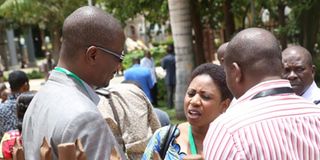
Mwananchi Communications Limited’s Executive Editor, Mr Bakari Machumu (left), and a member of the Constituent Assembly (CA), Mr Ezekiah Wenje, listen to a CA member, Ms Ummy Mwalimu, during the editor’s tour of Dodoma to witness CA activities. PHOTO | SILVAN KIWALE
What you need to know:
They say Constituent Assembly (CA) members like Dr Harrison Mwakyembe, who believe that the media should not be closely involved in the process on the grounds that there are special circumstances where rules of engagement should change, are dead wrong.
Dodoma. Is Tanzania at war to merit information censorship? Obviously not. The process of writing a new constitution is and must not be likened to a conflict situation, according to some media practitioners.
They say Constituent Assembly (CA) members like Dr Harrison Mwakyembe, who believe that the media should not be closely involved in the process on the grounds that there are special circumstances where rules of engagement should change, are dead wrong.
Dr Mwakyembe and like-minded people are using this assertion as an excuse to push their agenda, they say, adding that it is unfortunate that the Kyela MP, himself a former journalist, could believe that the media is a dangerous animal that should not be anywhere near CA members when they discuss the draft constitution.
They were reacting to the decision to bar the media from covering committee meetings, saying the move was ill-advised.
Among those who spoke out strongly against the decision was Tanzania Editors Forum deputy chairman Theophil Makunga, who said locking journalists out of the meetings did not make sense because the process of writing a new constitution was supposed to be open to public scrutiny.
Tanzanians also deserved to know what was happening at every stage of the process, he added.
Mr Makunga said he does not agree with Dr Mwakyembe’s assertion that Tanzania was in a situation that necessitated change in rules of engagement. On Thursday, Dr Mwakyembe was among CA members who backed the suggestion that the media be locked out of committee sessions because journalists could not be trusted.
But Mr Makunga said what Dr Mwakyembe’s statement was not logical because journalists covered wars, which the CA member described as “special situations”.
“I don’t understand what Dr Mwakyembe means. What does he mean by suggesting that journalists should not be allowed to attend committee sessions when debating the draft constitution? On what basis does he relate war situations and the constitution-making process?” queried the veteran journalist.
His position was supported by long-serving journalist and media consultant Lawrence Kilimwiko, who said the minister was wrong.
“Constitution-making is supposed to be an open process. There were no special qualifications set for people to be appointed CA members. Why has it suddenly become necessary to set qualifications for journalists who report the process?” he asked. Mr Kilimwiko said Dr Mwakyembe should understand that journalism had changed a great deal since the days he was a journalist in the 1970s.
Tabling the proposal that journalists be barred from covering committee meetings on Wednesday evening, Mr George Simbachawene said the previous suggestion that the sessions be open to the media was “unworkable”.
Mr Sibachawene, who is sits in the 20-member committee picked to refine the draft regulations, said the size of committee halls was too small to accommodate journalists and more than 50 committee members at once.
But after Mr Ezekiah Olouch warned that barring the media was unconstitutional, the story changed on Thursday, and the issue of space was swiftly dropped and members were told that the meetings were “too sensitive” for journalists to cover.
This is despite the fact that the media covered almost all public forums when the Constitutional Review Commission (CRC) went around the country to collect people’s opinions.
The views formed the basis of the first and second draft constitution prepared by the CRC. The CA has convened in Dodoma to debate the second draft.