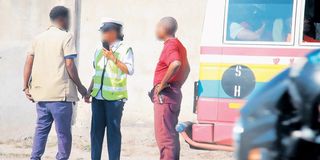
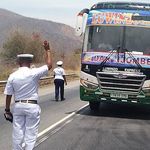
They explain that they are compelled daily to set aside funds for traffic officers to avoid fines for traffic violations involving their vehicles or sometimes for no apparent reason.
An investigation by Mwananchi (The Citizen’s sister paper) across various areas of Dar es Salaam has revealed that these drivers pay between Sh80,000 and Sh200,000 per day to vehicle owners, depending on the size of the vehicle and the distance traveled.
Additionally, they budget for fuel costs for the next day, with the remainder shared as allowances for themselves and the traffic police to ensure smooth operations.
Joram stated that he allocates between Sh10,000 and Sh15,000 to traffic police, highlighting Vingunguti and Kipawa as areas where he must remain vigilant, as traffic officers frequently stop along Nyerere Road. If stopped, he leaves Sh2,000 for the officer.
"The issue of giving money won't end because if you refuse, they fine you. So, if you're fined Sh30,000 and then show reluctance to give Sh2,000! That's unacceptable," said Joram, a viewpoint shared by other drivers.
Saleh Kassim, a dala-dala driver between Chanika and Gongo la Mboto, mentioned that traffic officers accept Sh2,000 for fines less than Sh30,000 but demand more if there are multiple offenses, possibly resulting in vehicle impoundment.
"If caught immediately after setting off or from the garage, you inform them you have nothing and promise to check later. Upon return, you settle with them. If you pretend to have forgotten, they detain you," he said, pinpointing Videte (Chanika), Magenge, Mapensheni, and Pugu Primary School as frequent stops for traffic officers.
On average, he estimates spending Sh10,000 on traffic officers, a sentiment echoed by John Gabriel, operating between Stesheni and Mbande.
Miraji Kiboko, a dala-dala driver between Homboza and Machinga Complex, noted that encounters with officers from Traffic Headquarters can escalate the demanded amount to Sh5,000.
"If you've ever seen officers gathered at the station, sometimes they park their vehicles nearby. If caught by them, expect the demand to be Sh5,000, not Sh2,000," he stated.
Conductor Samson, working on the Kigogo - Kivukoni route, explained how officers verify payments: "They know all vehicles on their assigned routes. So, if three are at the station, they coordinate to ensure each knows who has paid. They won't arrest you."
Nassor Imran, a dala-dala driver between Tegeta Nyuki and Mwenge, disclosed that daily earnings range from Sh130,000 to Sh180,000 based on passenger volume and traffic conditions. He deposits Sh100,000 daily to the vehicle owner, regardless of profitability, while setting aside Sh14,000 for traffic officers.
Given these circumstances, he admitted sometimes failing to share allowances with his conductor, although occasionally they earn satisfactory amounts. Some drivers are left with an average of Sh40,000 to share with conductors, depending on daily business, which may range from Sh25,000 to Sh20,000 on a bad day.
Nelson Manda, a conductor on the Mbezi - Mlandizi route, acknowledged that sometimes officers demand money even without traffic or vehicle safety violations.
"The vehicle has no faults, and if it's new, the owner has completed all necessary procedures. But with the officers, you have to pay," he said.
The issue of bribery among traffic officers, according to one driver, has deep roots, making it challenging to control.
"These days, we openly give Sh2,000. They don't hide. The reason they don't hide is that their superiors have sanctioned it, knowing no one can challenge them," he explained.
Morogoro Road
Drivers and conductors traveling between Mbezi and Mlandizi reported specific spots along Morogoro Road where they leave payments for officers, such as Kibamba by Mangi and Magari Saba.
They indicated that from 1:30 AM to noon, dala-dalas stop at these spots to hand over Sh2,000 to officers present.
"That's the procedure. You can't avoid it as a conductor or driver. Once you give Sh2,000, you can work in peace all day unless you've made a mistake," explained driver James Peter.
A journalist from Mwananchi stationed at Kibamba by Mangi on Friday, July 19, 2024, between 2:00 and 3:00 AM, witnessed three officers collecting money from dala-dala drivers and conductors arriving from Mlandizi to Mbezi.
After offloading passengers, the conductor, who counted the money on tickets, approached the driver and handed the officer, who was at the moment in a conversation with the driver.
At the Magari Saba station that Friday morning, July 19, 2024, at 4:00 AM, two officers were present, one in a blue jacket and khaki pants.
Before stopping, the dala-dala driver informed the conductor of the presence of a 'hawk.'
"He (referring to the officer in the blue jacket) doesn't accept Sh2,000 like the others," the driver said in his conversation with the conductor.
Later, they stopped another dala-dala, and Mwananchi observed the officer collecting Sh5,000.
Driver Rashid explained to Mwananchi that the officer often insists on receiving Sh5,000 to Sh10,000, and if not given that day, it becomes difficult to work.
"We give once a day, although some officers demand Sh5,000. Four years ago, these bribes were compulsory, and officers didn't hesitate to take them. Recently, they take them discreetly, but you can't pass a morning at Magari Saba or Kwa Mangi without paying that amount," he said.
John Tarimo, a driver between Gongo la Mboto and Kawe, stated that to avoid drawing attention from passengers, money is handed directly or hidden in tickets. The officer then issues a receipt to the conductor to confirm payment.
Said Rashid, a dala-dala driver from Buza to Mwenge, noted that officers claim the money is for shoe-polishing.
"If you start from Buza Kwalulenge, the first stop is Mama Kibonge, Temeke Usalama. Then at Tabata Mwananchi, and later Ubungo River Side and Mwenge border. At each stop, you must leave Sh2,000," he said.
Jackson Masia, a driver from Mnazi Mmoja to Simu2000 via Buguruni, commented, "Sometimes they even threaten to snatch the car keys if you refuse to part with the Sh2,000, publicly insulting us while passengers listen to humiliating words."
"In the morning, passengers are eager to reach their destinations. When officers stop you by the roadside and circle around, if you don't cooperate, they assume you're arrogant and unwilling," he said.
Shifwaya Lema, Secretary-General of the Dar es Salaam Regional Association of Dala-Dala Owners (Darcoboa), speaking to Mwananchi, mentioned that as an association, they have never received complaints from drivers.
"These are statements made by the drivers themselves, which could be accurate as they are the ones in the field. However, I can neither confirm nor deny them because no one has filed a direct complaint," he said.
He added that while they listen to driver and conductor grievances, this particular issue has not been formally discussed in their meetings.
"If such issues were raised, we would convene and collectively seek solutions to any challenges. Fortunately, we have a system where we liaise with the Police Force, particularly the Traffic Division, to resolve problems. However, without specific complaints, I cannot act on unsubstantiated claims," he said.
Traffic Police response
Responding to corruption allegations, Commander of the Traffic Safety Corps, Ramadhan Ng'anzi, acknowledged hearing complaints from drivers and conductors about such practices.
He assured that they are diligently investigating any officers involved in corrupt activities to take appropriate disciplinary action, including dismissal.
However, he admitted the challenge in combating these crimes due to the lack of direct evidence, which is crucial in proving the guilt of offenders.
"It seems both parties involved have interests, between the bribe giver and the recipient, and they operate discreetly, making evidence collection difficult," he explained.
Ng'anzi emphasized that any officer found guilty of corruption will face disciplinary measures according to the law. He added that several officers have been previously punished, including dismissal for corruption and embezzlement.
When asked about leaders in the force being implicated in these activities, he reiterated their responsibility to uphold the law and ensure compliance at all times.
Commander Ng'anzi stressed that anyone caught engaging in corruption with sufficient evidence will face disciplinary action according to the law.
PCCB's warning
Director of the Prevention and Combating of Corruption Bureau (Takukuru), Salum Hamduni, warned drivers and conductors against bribing traffic police officers, emphasizing the legal risks they face.
"The issue of corruption has two sides: the giver and the recipient. When drivers give bribes, it involves an agreement between them and the recipients.
"I advise these drivers not to engage in bribery. Instead, if pressured or asked, they should report to the police or PCCB so that action can be taken," he said.
Hamduni mentioned that they continue to monitor such acts and take necessary steps upon discovering offenses.
"We employ various measures, including educating the Police Force's Traffic Division on the dangers of corruption," he said, adding, "We have also reported numerous cases resulting in dismissals and prosecutions."
Continues tomorrow……
Register to begin your journey to our premium contentSubscribe for full access to premium content