Graduates in Tanzania to use certificates as loan collateral
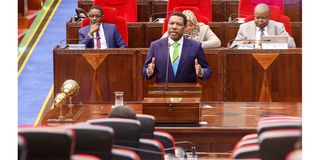
Prime Minister Mwigulu Nchemba responds to MPs’ questions during the Question and Answer session at the Parliamentary sitting in Dodoma yesterday. PHOTO | PMO
What you need to know:
Once passed, the law is expected to unlock access to credit for thousands of young graduates who have long been shut out of the financial system due to lack of traditional assets such as land or property
By Katare Mbashiru
Dodoma. Graduates in Tanzania could soon walk into financial institutions with nothing but their academic certificates and walk out with government-backed loans, following a major policy shift announced by Prime Minister Dr Mwigulu Nchemba.
Dr Nchemba made the revelation in Parliament yesterday, during the Prime Minister Question and Answer session.
He was responding to questions from Members of Parliament, Timida Fryandomo (Special Seats) and Isack Copriano (Monduli), who sought to know the government’s plans to address unemployment among graduates.
Dr Nchemba revealed that the government is finalising legislation that will formally recognise university and professional certificates as acceptable collateral for loans.
Once passed, the law is expected to unlock access to credit for thousands of young graduates who have long been shut out of the financial system due to lack of traditional assets such as land or property.
The proposal offers a breakthrough to a long-standing concern among youth and policymakers alike: how to empower educated but unemployed graduates to participate in the economy.
For years, critics argued that it was unjust for graduates, who spent heavily on tuition to earn their qualifications, to remain ineligible for loans simply because they lacked physical collateral.
Under the new framework, certificates will be treated as movable assets, enabling graduates to secure financing to invest in businesses, innovation, and other income-generating activities.
According to Dr Nchemba, the government has already set aside Sh280 billion in substantial funds to support youth economic initiatives, signalling readiness to operationalise the plan once the legal foundation is in place.
The premier noted that the initiative comes at a time when many educated young people remain unemployed, with some increasingly dependent on their families despite holding degrees.
The policy is also aligned with broader national targets to create millions of jobs in the coming years. Youth employment remains a major challenge at both global and national levels, with Tanzania recording an unemployment rate of 11.5 per cent.
While debating the estimates for the Prime Minister's Office in Parliament, Kisarawe lawmaker Selemani Jafo proposed an immediate solution to curb youth unemployment. He insisted that the government had a clear plan for Vision 2050, which outlines several priorities, including issues that are essential to addressing youth unemployment.
“It is high time the government considered employing at least 50,000 Tanzanian citizens. Diploma holders could receive monthly stipends of up to Sh500,000, while degree holders could be paid up to Sh700,000” said Mr Jafo, who doubles as the former Cabinet minister.
He suggested a three-year contract as the initial implementation plan for the part-time project.
In his calculations, the Kisarawe MP said the government would spend at least Sh326 billion to implement the project, which, if successfully executed, could help reduce unemployment in Tanzania.
This is despite high rates of economic growth in the past decade, averaging seven percent.
However, the rapid gains in economic growth and education have not translated into productive and decent employment significant enough to alleviate poverty.
Alongside the financial reforms, the government is tightening accountability in the public sector, announcing that promotions for civil servants will now be strictly based on performance rather than years of service.
The Prime Minister said improved monitoring and evaluation systems are being rolled out to ensure that directives issued during official visits are effectively implemented and deliver tangible results to citizens.
The government has also moved to ease pressure on families by directing local authorities to fund volunteer teachers from internal revenues, reinforcing its commitment to free basic education.
Officials acknowledged that unregulated school contributions have burdened parents and risk undermining access to education.
Together, the reforms paint a picture of a government seeking to match opportunity with merit, giving graduates the financial tools to build their futures while demanding measurable results from those entrusted with public service.
With over 900,000 young Tanzanians entering the labour market each year and only a fraction securing formal jobs, youth inclusion has become a pressing issue.
The World Bank’s country director, Mr Nathan Belete, was recently quoted as saying that by 2030, 1.6 million youth will be entering the labour market annually in Tanzania; thus, substantial and smart investment in the personal and economic vitality of this generation will be required.