Procurement compliance rises to 79pc amid persistent gaps, PPRA report shows

Director General of the Public Procurement Regulatory Authority (PPRA), Mr Dennis Simba, presents a summary of the institution’s annual performance report at State House in Dar es Salaam on March 30, 2026.

Dar es Salaam. Compliance with public procurement laws in Tanzania has risen to 79 percent, signalling progress in reforms, but widespread violations and systemic weaknesses continue to undermine accountability and value for money, a new report shows.

The latest Public Procurement Regulatory Authority (PPRA) report, presented to President Samia Suluhu Hassan alongside those of the Controller and Auditor General (CAG) and the Prevention and Combating of Corruption Bureau (PCCB) on Monday, March 30, 2026, paints a mixed picture of gains and persistent challenges.
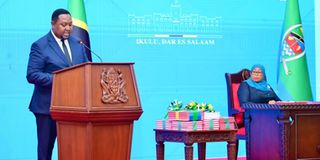
Presenting the report, PPRA Director General Denis Simba said compliance improved from 76 percent in 2023/24 to 79 percent in 2024/25, continuing an upward trend from 63.5 percent in 2021/22.

“In the 2024/25 financial year, compliance with procurement laws increased from 76 percent to 79 percent,” he said, attributing the gains to enforcement of the 2023 procurement law and expansion of the National e-Procurement System (NEST).

The digital system has become a key driver of efficiency. During the year under review, new modules—including electronic contract management and an appeals system—were introduced, while 6,921 grassroots institutions such as schools and health facilities were integrated into the platform.

“The use of NEST has improved efficiency by reducing the time required to complete tendering processes,” Mr Simba said.

Procurement activity also expanded sharply, with the number of tenders advertised rising by 72 percent from 53,221 to 99,823, while bidder participation nearly doubled, reflecting growing competition.

The report estimates that institutions saved about Sh13.3 billion in operational costs due to reduced reliance on paper-based processes, alongside environmental gains from lower carbon emissions. NEST has also been integrated with 21 government systems, improving real-time data sharing and oversight.

However, despite these improvements, the report highlights serious compliance gaps. A total of 756 out of 943 procuring entities failed to allocate the mandatory 30 percent of procurement budgets to special groups, including youth, women, the elderly and persons with disabilities.

Other irregularities include procurement conducted outside official systems, tender awards that did not follow evaluation criteria, and weak contract management leading to delays, abandoned projects and payments for unexecuted work.

“In some cases, payments were made for work that had not been executed,” Mr Simba said.

Value-for-money audits further revealed uneven performance, with a number of contracts failing to deliver expected results, raising concerns about the efficiency of public spending.

In response, PPRA has introduced corrective measures, including real-time monitoring dashboards and system upgrades incorporating data analytics and artificial intelligence to detect irregularities.

“We have rolled out real-time monitoring systems to strengthen compliance and oversight,” he said.

The authority is also moving to enforce full adoption of NEST by linking it with government payment systems to prevent off-platform transactions.

Mr Simba said the reforms aim to strengthen transparency, accountability and efficiency in the use of public funds, noting that procurement remains central to service delivery and national development.