Salim legacy fuels debate on self-reliance across Africa
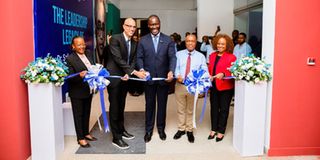
Ambassador John Ulanga, Director of Economic Diplomacy at the Ministry of Foreign Affairs cuts a ribbon to officially launch an exhibition of Dr. Salim Ahmed Salim, a former the then Organisation of African Union ( OAU, now African Union- AU) that was organised by Kengo Limited and supported by Karimjee Foundation at National Museum in Dar es Salaam. PHOTO | CORRESPONDENT
Josephine Christopher is a senior business journalist for The Citizen and Mwananchi newspapers
Mwananchi Communications Limitted
Dar es Salaam. A month-long exhibition celebrating the legacy of former African diplomat Salim Ahmed Salim has opened at the National Museum of Tanzania, drawing diplomats, scholars and policymakers into renewed debate on Africa’s economic independence and its reliance on foreign capital.
The exhibition, hosted at the National Museum of Tanzania in collaboration with the Salim Ahmed Salim Digital Archives, features photographs, speeches, diplomatic records and correspondence documenting Dr Salim’s long career in African and international diplomacy.
Organisers said the showcase aims to make the digital archive more accessible to the public, particularly younger generations, by bringing selected historical materials into a physical exhibition space.
However, the opening ceremony quickly moved beyond commemoration, evolving into broader reflections on Africa’s development trajectory and economic future.
Retired diplomat Ami Mpungwe said Dr Salim’s generation had largely achieved its historic mission of liberation and African unity, but warned that the current generation now faces a different challenge.
“The generation of Salim fulfilled its mission. The responsibility now is for the current generation to ask itself: what is its mission?” he said.
Mr Mpungwe also underscored the importance of preserving historical records, saying African leaders have often underestimated the value of institutional memory.
He said the archive provides an opportunity for younger Africans to better understand the reasoning behind key diplomatic and political decisions that shaped the continent’s post-independence path.
“How can we be rich and poor at the same time?” he asked, pointing to Africa’s continued paradox of resource wealth alongside widespread poverty.
He argued that Africa had gradually drifted away from the founding principles of independence-era leadership, including commitments to social justice and inclusive development.
Mr Mpungwe further noted that external lenders and development institutions increasingly impose governance and human rights conditions on African countries.
, despite these being ideals once strongly advocated by liberation movements.
“It reaches a point where those who once gave us independence reminders are now the ones reminding us about commitments we made ourselves,” he said.
He called for stronger domestic ownership of economic strategies, warning against overdependence on externally designed development models.
Director of Economic Diplomacy at the Ministry of Foreign Affairs and East African Cooperation, John Ulanga, said the role of diplomacy has evolved significantly since Dr Salim’s era.
He said earlier diplomatic efforts focused largely on political liberation and solidarity, while today’s focus is centred on attracting investment, mobilising capital and expanding market access.
“The mission of this generation should be to mobilise as much capital as possible around the world to economically liberate Tanzania and Africa,” he said.
Mr Ulanga called for stronger intergenerational dialogue between veteran diplomats and emerging policymakers to ensure Africa adapts to shifting global economic realities.
He added that economic diplomacy must now play a central role in advancing industrialisation and improving trade competitiveness.
Dr Salim’s son, Ahmed Salim, said the exhibition highlights Tanzania’s historic role in global diplomacy and the influence its leaders once held on the world stage.
“The archive shows how important Tanzania was, and still is, globally, and how many leaders looked to Tanzania for advice and counsel,” he said.
He added that the exhibition offers rare insight into behind-the-scenes diplomatic engagements that are often not captured in public historical records.
“For the first time, people are able to see what happened in those meetings and understand the substance behind the images,” he said.
Register to begin your journey to our premium contentSubscribe for full access to premium content