Secret to making TZ dairy industry more productive
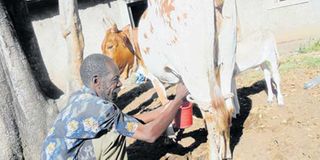
Resident of Nkilizya Village, Ukerewe District, Alex Katyali, milking his cattle which produces up to four littres per day for sale. Economists are proposing strong measures to control the rate of milk imports to help local producers and processors. Photo |File
What you need to know:
Ranking third on cattle population in Africa, experts say Tanzania has the great potential of improving the standard of living through cow milk consumption and sales of different cow milk products.
Dar es Salaam. Tanzania ranks third in Africa in terms of cattle population after Sudan and Ethiopia. And the split of the war-torn Sudan into two countries---North and South---has placed Tanzania second after Ethiopia.
It is estimated that there are over 21.3 million cattle in Tanzania, where 680,000 are dairy cattle with the capacity to produce 1.65 billion litres annually, making the country the third milk producer in East Africa after Kenya and Uganda.
Kenya, Sudan and Egypt also rank among the top milk-producing countries on the continent, all contributing significantly to Africa’s 13.4 million dairy farms.
With these impressive statistics, one would have expected Tanzania to be ahead of Kenya and Uganda in the production of milk and other products such as meat, hides and skins.
What we see instead, is a shocking level of Tanzania’s milk import. A study by the Economic and Social Research Foundation (ESRF) has provided a better understanding of the impact that milk imports has on Tanzania’s dairy markets.
The livestock industry accounts for 4.4 per cent of the Gross Domestic Product (GDP), with the dairy sub-sector contributing 30 per cent of this output. Dairy industry is reported to be an important component in livestock sector with great potential of improving the standard of living of people through cow milk consumption and sales of different cow milk products.
The diary sector, though not fully commercialised, employs more than two million households and over 100,000 intermediaries through their participation in milk processing and marketing.
Over the last two decades, the total milk production has increased at 2.8 per cent per annum, largely due to increase in cattle population rather than increases in productivity. The per capita milk consumption is 45 litres per person per year against 130 litres and 80 litres for Kenya and Uganda respectively.
According to the Tanzania Revenue Authorities (TRA) 2016 records, Tanzania had imported 36, 766 tons of milk worth Sh90 billion between the 2011 and 2013,
Out of this, 14,500 tons were powder milk worth Sh47 billion while the rest was in the form of concentrate. This means that 40 per cent of milk imported to Tanzania was powder milk, which cost more than 50 per cent of the total amount spent by the country for importing milk.
Statistics by UNCOMTRADE, the United Nations Statistics Division, published in 2016 show that Tanzania imported 85, 000 tons of milk products worth $109.6 million between 2011 and 2014, of which 17, 000 tons were powder milk worth $20.3 million.
However, the ESRF study commissioned by the Tanzania Milk Processors Association (TAMPA) acknowledges the comparative advantage that Tanzania has in terms of the suitability of the environment for dairy farming.
Leading milk producing regions such as Mbeya, Musoma and Kilimanjaro have been successful due to favourable weather conditions that support the subsector. In such regions, production is very high especially during rainy seasons, but due to lack of reliable markets several litres of milk are wasted.
It is important to take strong measures to control the rate of milk imports, even though the biggest market is in Dar es Salaam. Most worrying fear raised amongst some of the stakeholders, is the probability of local processors to switch to imported powder milk in processing adulterated UHT milk.
UHT is the process that gives milk a longer shelf life in which milk is heated to 280 degrees Fahrenheit for two to four seconds, killing any bacteria in it.
This is an alarming situation which, if not addressed, may eventually impact significantly on more than two million households depending on milk.
With this situation, investment in long shelf-life (LSL) milk processing by the private sector will be crucial and highly recommended to overcome the huge projected milk deficits
Currently, there are 74 dairy plants operating at 30 per cent capacity which produce mainly short shelf life products like pasteurized yoghurt, etc.
LSL dairy product processing needs to be undertaken, especially during the rainy season flush periods of too much milk supply.
The LSL strategy includes additional LSL dairy plants: 3 UHT and 2 powder milk processing plants (2 UHT and 1 powder plant in the Highlands and 1 UHT and 1 powder plant in Lake & Coastal zone
The key policy changes needed are incentives to increase investment in long shelf-life (LSL) milk processing and milk quality standards enforcement
In this context, Tanzanian producers and value chain actors need a much-improved business environment. Stakeholders in the sector urged the government to introduce quotas for milk imports so as to control and regulate milk importation.
Given its asset base of so many animals, Tanzania is in a good position to tap into this rapidly rising market value of Africa’s animal-source foods that is estimated at $151 billion by 2050.
This presents significant opportunities for private-sector investment, whether that be investing in production or in the provision of livestock inputs and services for the abudance of small- to medium-scale livestock operations that characterize livestock systems in today’s developing and emerging economies.
Dr Amos Moore, country representative of the International Livestock Research Institute (ILRI) in Dar es Salaam once said: “Whether public or private investments, the key question right now is to identify the right entry points that avoid the missteps of the past.”
The writer is ANSAF Head of Media and Communications