Son’s question drove my return to Chadema, reveals Rev Msigwa
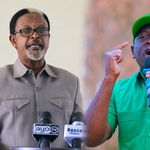
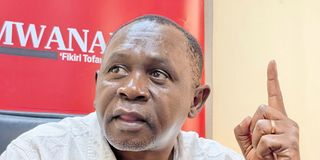
Chadema cadre, Rev Peter Msigwa (left), gestures during an interview at the Mwananchi Communications Ltd newsroom in Dar es Salaam June 02, 2026. PHOTO | SAID POWA
Dar es Salaam. Former Iringa Urban MP, Peter Msigwa, has revealed that a question from his 18-year-old son became the turning point that prompted him to leave CCM and return to Chadema.
Rev Msigwa, who represented Iringa Urban through Chadema for a decade, defected to CCM on June 30, 2024, before announcing his return to the opposition party on May 23, 2026.
He says the events surrounding the October 29, 2025, General Election, played a decisive role in his decision.
Speaking in an exclusive interview during his tour of Mwananchi Communications Limited (MCL) newsroom at Tabata Relini yesterday, Rev Msigwa said he spent months reflecting on his political future after reports of killings during and after the election.
He said family discussions and a troubled conscience forced him to reassess his position and conclude that leaving Chadema had been a mistake.
The defining moment, he said, came when his son asked whether he would still be praising CCM if his three sons had been among those killed.
“My conscience began troubling me after the election because of the unprecedented killings that occurred in our country. My son asked me:
‘Dad, if my two brothers and I had been among those who died, would you still be saying long live Chama Cha Mapinduzi?’” recalled Rev Msigwa.
“When I combined that question with what my conscience was already telling me, I realised we were not on the right path as a nation…,” he added.
Rev Msigwa said the question reinforced concerns he had already been grappling with while watching events unfold, and convinced him that the country was heading in the wrong direction.
“I returned to Chadema after apologising and being forgiven for the mistakes I made.
I ask everyone I offended within the party to forgive me because I never expected an election to be conducted in a manner that would result in loss of life,” he said.
According to him, the events of October 2025 fundamentally changed his view of CCM, its philosophy, and its relationship with citizens.
“I went to vote, but what I witnessed at the polling station was beyond anything I expected. It raised many questions and forced me to reflect,” he said.
The veteran politician said his return to Chadema had drawn mixed reactions. Some supporters welcomed him back, while others remained sceptical about his motives.
“I expected all reactions. Those who criticise me, those who doubt me, and those who support me are all my people,” he said.
“My only request to those who doubt me is to give me time. As a believer, I know people are judged by their fruits,” he said.
Rev Msigwa dismissed claims that he returned to Chadema after failing to secure a position in CCM.
“If I wanted positions, they are available in CCM. I could have remained there, continued praising the party, and waited for an appointment,” he said.
“Given my credentials, remaining in CCM would have benefited me. But I chose to return to a place where I believe in standing by my principles,” he added.
Drawing a parallel with the biblical story of Moses, he said that despite enjoying life under Pharaoh’s rule, Moses eventually chose to stand with his own people.
“Despite the benefits I could have enjoyed in CCM, I chose to return to where I believe my calling lies.
This is where my happiness lies,” he said. Reflecting on his time in CCM, Mr Msigwa said he leaves with both lessons and regrets.
On the positive side, he said the ruling party is disciplined and follows established procedures in implementing its activities.
However, he argued that CCM has become increasingly dependent on state institutions to win elections. “What saddens me is that CCM can no longer win elections without relying on the state. That is dangerous for national stability,” he said.
According to Mr Msigwa, such dependence undermines the independence of institutions including the judiciary, Parliament, the police, and the Independent National Electoral Commission (INEC).
“When citizens begin to see courts serving the interests of a few people, they lose confidence. When they see Parliament failing to speak for them or hold the government accountable, they also lose confidence,” he said.
He warned that erosion of public trust creates pressure within society and weakens democratic governance.
“The soul of a nation lies in independent courts, professional police officers, and a Parliament that holds the government accountable. When that independence disappears, people begin to drift towards authoritarianism,” he said.
Asked whether he attempted to push for reforms while in CCM, Mr Msigwa said he occasionally expressed his views but acknowledged that it was not always easy to influence decision-making within such a large political party.
He maintained that Tanzania needs constitutional reforms, independent electoral institutions, and greater willingness among leaders to listen to citizens.
Mr Msigwa also said politicians should neither oppose everything nor defend everything simply because of party loyalty.
“I have learned to rise above party politics on fundamental issues. There have been improvements in classrooms, health facilities, and maternal and child health outcomes,” he said.
“But development achievements cannot be used to justify violations of human rights. That is a lesson I carry with me from my time in CCM,” he added.
“When citizens begin to see courts serving the interests of a few people, they lose confidence. When they see Parliament failing to speak for them or hold the government accountable, they also lose confidence,” he said.
He warned that erosion of public trust creates pressure within society and weakens democratic governance.
“The soul of a nation lies in independent courts, professional police officers, and a Parliament that holds the government accountable. When that independence disappears, people begin to drift towards authoritarianism,” he said.
Asked whether he attempted to push for reforms while in CCM, Mr Msigwa said he occasionally expressed his views but acknowledged that it was not always easy to influence decision-making within such a large political party.
He maintained that Tanzania needs constitutional reforms, independent electoral institutions, and greater willingness among leaders to listen to citizens.
Mr Msigwa also said politicians should neither oppose everything nor defend everything simply because of party loyalty.
“I have learned to rise above party politics on fundamental issues. There have been improvements in classrooms, health facilities, and maternal and child health outcomes,” he said.
“But development achievements cannot be used to justify violations of human rights. That is a lesson I carry with me from my time in CCM,” he added.
Register to begin your journey to our premium contentSubscribe for full access to premium content