Students from far-off villages in Singida rent rooms to be close to this school
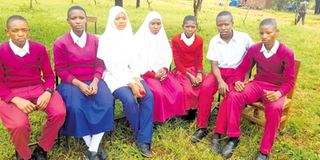
Some of the students who have resorted to renting rooms close to their school. Photo | Salome Gregory
What you need to know:
Mwangeza Secondary School has 166 students from various villages.
Mkalama. Since there are no hostels, accommodation is tough for secondary school students in Mkalama District, Singida Region. Mwangeza Secondary School has 166 students from various villages.
Dominiki Village is 7km away from the school while Munguli is 12km away. Other villages with their distances in kilometres from Mwangeza Secondary School in brackets are Matele (15), Midibwi (17), Ilamoto and Ikolo (28) as well as Endasiku (over 30km).
Students hire rooms close to school for convenience.
But second master Rashid Hussein says it is difficult for such students to look for food after class hours and do other work including revising notes.
Pili Bakari, 17, is a Form III student at Mwangeza. She joined the school from Ilamoto Primary School where she used to walk 10km a day. It was not easy for her parents to decide if she could join the school due to the long distance as she had to pass through six villages to reach Mwangeza.
“My parents hired a room for me at Kijiweni. They pay Sh10,000 every month. We are 10 girls from different places. Soon after class hours at 5pm we fetch water, cook meals, wash clothes and dishes on our own. After we are done with this we are all tired and we cannot do revisions,” says Pili.
It takes Pili and her friends four hours to fetch water. Cooking and other chores always end at 11pm. Then they just go on bed, tired, with little time of revising notes!
Thabit Mangu,18, is a Form III student who came from Mitala Primary School. After he passed his parents hired a room for Sh15,000. Most of the time, he sleeps without eating as the money he gets from home (Sh30,000) is not enough to keep him for six months.
“Although my parents brought me close to school, challenges are still there as not every day I get food. Most of the time we sleep without eating until friends help us,” he says.
The school has no lab. “We only learn theories,” Thabit reveals.
He called upon authorities to help Mkalama schools.
Meanwhile, a Legal and Human Rights Centre (LHRC) suggested that strategies of improving the quality of education in public schools should be devised to complement improved access to education through free basic education.
The challenges include teachers’ welfare, shortage of classrooms and shortage of latrines both in public primary and secondary schools.
HakiElimu in its study found out that 45 per cent of teachers believe that the free education policy would cover all education expenses, which is not the case.
Then LHRC executive director Helen Kijo-Bisimba said, another challenge brought by the policy is too many pupils in classrooms in both primary and secondary schools following an enrolment expansion. She said the teacher-student ratio has risen to 1:164 instead of the standard 1:45.
According to Unicef, despite the positive progress in primary Net Enrolment Ratio (NER), the increase from 89 per cent in 2003 to 97 per cent in 2007 could not be sustained. Primary School NER declined to 85.6 per cent in 2016.
It notes that only 47 per cent of all 5-year-olds are enrolled at the pre-primary school level in 2015. This ranges from 27 per cent in Manyara to 80 per cent in Mara.
Primary school-aged children from the poorest families are three times less likely to attend school than those from the wealthiest households.
While it is estimated that 7.9 per cent of Tanzanians are living with a disability, less than 1 per cent of children in pre-primary, primary and secondary school have a disability.