Tanzania's economy grew by 5.9pc as country concluded Vision 2025
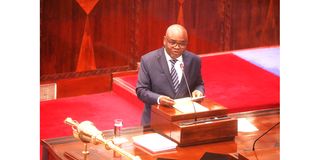
Minister of State in the President’s Office for Planning and Investment, Professor Kitila Mkumbo, presents the 2026/27 National Development Plan ahead of the Government Budget presentation in Parliament in Dodoma. PHOTO|SAID NANJUNDU.
Dar es Salaam. Tanzania's economy grew by 5.9 percent in 2025, up from 5.6 percent in 2024, as the country concluded implementation of its Development Vision 2025 and prepared to embark on the newly adopted Vision 2050 development agenda.
Presenting the State of the Economy Report for 2025 and the National Development Plan for 2026/27 in Parliament on Thursday, Minister of State in the President's Office (Planning and Investment), Prof Kitila Mkumbo, said the latest performance reflected continued economic resilience despite global uncertainties.
According to the report, gross domestic product (GDP) expanded to Sh234.1 trillion in 2025 from Sh211.98 trillion recorded in 2024 following the completion of GDP rebasing using 2019 as the benchmark year.
"According to the new statistics based on the 2019 benchmark year, real GDP grew by an average of 5.9 percent in 2025 compared with 5.6 percent in 2024," Prof Mkumbo told Parliament.
The country's GDP per capita rose by 7.4 percent to Sh3.54 million ($1,390), up from Sh3.30 million ($1,264) in the previous year.
Agriculture remained the largest contributor to the economy, accounting for 24.3 percent of GDP, followed by construction at 11.9 percent, mining at 10.3 percent, trade and repair services at 8.6 percent and transport and storage at 8.3 percent.
Among the fastest-growing sectors were financial and insurance services, which expanded by 15.7 percent, electricity and gas at 11.8 percent, mining at 9.4 percent and information and communication at 8.8 percent.
The report also showed that inflation remained relatively stable despite global economic pressures.
Average inflation stood at 3.3 percent in 2025, slightly higher than 3.1 percent recorded in 2024, largely due to increased food prices.
However, the rate remained within the government's medium-term target range of between three and five percent and met the convergence criteria of both the East African Community (EAC) and the Southern African Development Community (SADC).
"Despite the increase, the rate remained within the national medium-term target and satisfied the economic convergence criteria of both EAC and SADC," said Prof Mkumbo.
Within the EAC, Tanzania recorded one of the lowest inflation rates, compared to Kenya's 4.5 percent, Uganda's 3.6 percent and Rwanda's seven percent.
The report further revealed that poverty levels continued to decline, although the government acknowledged that the pace of reduction remains slower than desired.
Results of the 2025 Household Budget Survey showed that the proportion of Tanzanians living below the basic needs poverty line in Mainland Tanzania fell to 25.1 percent, compared with 26.4 percent in 2018, 28.2 percent in 2012 and 34.4 percent in 2007.
"The trend shows that greater efforts are required to accelerate poverty reduction so that it matches the pace of economic growth as envisioned under Vision 2050," Prof Mkumbo said.
The government now projects economic growth of 6.3 percent in 2026.