Tanzania Premier Nchemba pushes for swift law to control medical costs
Prime Minister, Dr Mwigulu Nchemba
What you need to know:
There have been numerous complaints from people across the country about consultation fees charged at different medical facilities, where patients are required to pay between Sh5,000 and Sh30,000 to see a doctor. This has complicated access to medical services because many cannot afford the costs
By Katare Mbashiru
Dodoma. Prime Minister, Dr Mwigulu Nchemba, has directed the Ministry of Health to urgently fast-track legislation aimed at standardising medical service charges across all health facilities nationwide.
The Prime Minister believes the measure will simplify access to healthcare and shield citizens from arbitrary consultation fees.
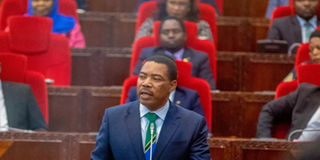
Dr Nchemba issued the directive in Parliament on Thursday, January 29, 2026, while responding to a question from Ushetu Member of Parliament Emmanuel Cherehani during his maiden session of impromptu questions to the Prime Minister.
Mr Cherehani told the House that patients across the country were increasingly complaining about being charged consultation fees ranging from Sh5,000 to Sh30,000 before seeing a doctor, despite medical practitioners already receiving salaries from the government.
“There have been numerous complaints from people across the country about consultation fees charged at different medical facilities, where patients are required to pay between Sh5,000 and Sh30,000 to see a doctor. This has complicated access to medical services because many cannot afford the costs,” he said.
The lawmaker questioned why such fees should continue to be charged, arguing that doctors ought to be adequately remunerated through government salaries.
In response, Dr Nchemba said the government recognises the burden these charges place on citizens and has instructed the Ministry of Health to finalise procedures for establishing a legal framework that will ensure uniformity in medical service charges nationwide.
“We want a system that guarantees fairness and easy access to health services at all health facilities,” said Dr Nchemba.
The Ushetu MP also raised concerns over frequent failures of electronic systems at some health facilities, which he said were delaying service delivery and disproportionately affecting women and children.
Dr Nchemba directed health facility authorities to ensure that electronic systems are operational at all times, stressing that technology should facilitate, rather than hinder, service provision.
Meanwhile, as the government rolls out the Universal Health Insurance (UHI) scheme, Special Seats MP Ritta Kabati expressed concern that many Tanzanians lack adequate understanding of the benefits and scope of the programme.
She asked the government to outline its plans to intensify public awareness campaigns to ensure widespread enrolment.
Dr Nchemba told Parliament that preparations for a nationwide awareness drive are underway and urged all Tanzanians to register under the UHI scheme in order to access healthcare services without financial barriers.
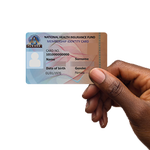
According to Ministry of Health statistics, only 15 percent of Tanzanians are currently registered with the National Health Insurance Fund (NHIF), while the remaining 85 percent pay for medical services out of pocket.
It is this low insurance coverage that prompted Tanzania to officially launch its mandatory UHI scheme on January 26, 2026, under the Universal Health Coverage (UHC) legislation.
The new scheme requires households to contribute Sh150,000 annually and seeks to integrate NHIF with private insurance schemes into a single national system.
The government states that the reforms are part of broader efforts to ensure equitable, affordable, and accessible healthcare services for all citizens.