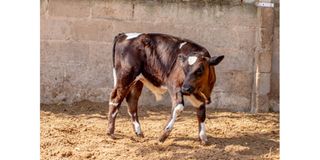
Iringa. Tanzania has recorded what is believed to be its first commercially managed embryo transfer to result in the birth of a healthy purebred dairy calf under the full supervision of local embryo transfer specialists, marking a significant step in the country's livestock sector.
The breakthrough, announced by URUS Tanzania on Friday, July 17, is expected to improve access to high-quality dairy genetics and help farmers build more productive herds without importing live animals.
The embryo transfer procedure was led by URUS Tanzania's Southern Highlands Regional Sales Manager, Mr Ramadhani Mwevirah, one of the country's trained embryo transfer specialists.
Speaking during a media tour of the Iringa farm where the calf was born, Mr Mwevirah said the achievement demonstrates that Tanzanian farmers can now access advanced breeding technologies previously available in only a few countries.
"This is more than the birth of a calf. It demonstrates that Tanzanian farmers now have access to world-class genetics without importing live animals," he said.
He explained that embryo transfer allows farmers to produce elite dairy cattle capable of yielding more than 40 litres of milk a day while significantly reducing the time required to improve herd genetics.
Embryo transfer involves implanting an embryo collected from a genetically superior donor cow into a healthy recipient cow. The resulting calf carries the complete genetics of the donor and sire, making it a purebred animal rather than a crossbreed.
According to Mr Mwevirah, conventional artificial insemination typically requires five to six generations of breeding, taking between 11 and 13 years, for farmers to achieve near-purebred genetics. Embryo transfer, however, delivers comparable genetic gains within a single generation.
He added that the technology is also more cost-effective than importing live cattle, while reducing transport stress, biosecurity risks and the challenges associated with adapting animals to new environments.
The innovation supports the government's Livestock Sector Transformation Plan (2022/23–2026/27), which identifies low genetic potential among indigenous cattle as one of the key factors limiting livestock productivity and milk production.
As demand for milk and dairy products continues to rise, improved genetics are expected to play an important role in increasing milk yields, improving farm profitability and strengthening national food security.
Mr Mwevirah said embryo transfer should be viewed as a long-term investment in the country's dairy industry.
"Every generation matters in cattle breeding. Embryo transfer allows farmers to leap forward instead of waiting more than a decade to achieve similar genetic progress," he said.
The first farmer to benefit from the technology, Mr Gallus Msekwa of Iringa Region, said the successful birth had strengthened his confidence in the future of his dairy enterprise.
"Seeing this healthy purebred calf born on my farm gives me confidence that Tanzanian farmers can now access the same quality genetics used by leading dairy producers around the world," he said.
URUS Tanzania Country Manager, Mr Edson Mfuru, said the milestone reflects the company's commitment to supporting Tanzania's livestock transformation through advanced breeding technologies.
"This milestone reflects our commitment to giving Tanzanian farmers access to advanced breeding technologies that improve productivity, profitability and sustainability," he said.
The company said it plans to expand embryo transfer services across the country to accelerate genetic improvement, increase milk production and support the modernisation of Tanzania's dairy and beef industries.