TRA taps public innovation drive to widen revenue base
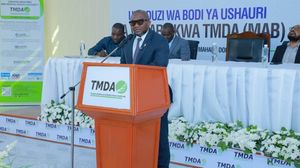
The Commissioner General of the Tanzania Revenue Authority (TRA), Yusufu Mwenda, speaks at the launch of the second phase of receiving innovative ideas from the public to expand the tax base and improve services, in Dar es Salaam. PHOTO | MICHAEL MATEMANGA
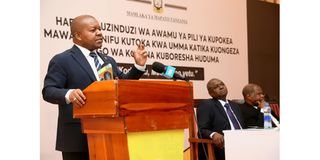
The initiative is part of a broader reform agenda aimed at strengthening trust, boosting voluntary compliance
Dar es Salaam. The Tanzania Revenue Authority (TARA) has unveiled an ambitious strategy to expand the country’s tax base, placing citizens and technology at the centre of its next phase of revenue mobilisation.
In a move that signals a shift from traditional enforcement to collaborative innovation, the authority has launched the second phase of its public ideas initiative, an approach designed to unlock practical solutions for widening tax collection, particularly in the largely untapped informal sector.
Launching the second phase of the programme on April 29, 2026, TRA Commissioner General, Mr Yusuph Mwenda, said the initiative is part of a broader reform agenda aimed at strengthening trust, boosting voluntary compliance, and ultimately increasing domestic revenue.
“This phase is about deepening public participation and building confidence. We want citizens to be part of the solutions in expanding the tax base,” said Mr Mwenda.
At the core of TRA’s plan are six priority areas that reflect persistent gaps in Tanzania’s tax system.
These include expanding tax coverage in the informal sector, improving tax estimation for small businesses, enhancing digital tax services and administration, leveraging technology in revenue collection, strengthening tax dispute resolution mechanisms, and promoting voluntary compliance.
According to the authority, the informal sector, estimated to account for over 40 percent of Tanzania’s economy, remains one of the biggest frontiers for revenue expansion.
Bringing more of these businesses into the tax system without stifling their growth has long been a delicate balancing act.
Director of Research and Planning at TRA, Mr Ephraim Mdee, said the new phase is deliberately structured to attract ideas that are practical and scalable. “We will assess submissions based on their feasibility, their contribution to increasing government revenue, their ability to improve taxpayer services, and their level of innovation,” he explained.
Notably, TRA has also reformed the evaluation process by establishing an independent 12-member panel drawn from various sectors, distancing itself from direct involvement in judging submissions aiming to enhance transparency and credibility.
The initiative comes at a time when TRA has recorded significant gains in revenue collection, underpinned by digital reforms and improved compliance systems.
In recent years, the authority has consistently exceeded its collection targets, with government data showing annual domestic revenue rising from about Sh15 trillion a decade ago to over Sh30 trillion in the latest financial cycle.
Analysts attribute this growth to systems such as electronic fiscal devices (EFDs), online tax filing platforms, and tighter enforcement measures.
Mr Mwenda said the innovation drive is intended to sustain this upward trajectory by addressing structural challenges that technology and enforcement alone cannot fully resolve.
“In the first phase, we received 5,681 ideas from the public. Out of these, 106 were shortlisted for detailed evaluation, and nine emerged as winners. Importantly, all viable ideas are still being refined for implementation,” he said. He acknowledged that the initial phase faced criticism over transparency and independence, but assured stakeholders that those shortcomings have been addressed.
TRA’s renewed focus on digital systems is expected to play a critical role in widening the tax base. The upgraded online platform allows participants to submit and track their ideas from submission to evaluation, enhancing accountability in the process.
Mr Mwenda emphasised that proposals must demonstrate how technology can be used to reach more taxpayers and simplify compliance.
“We are looking for ideas that show how technology can make tax collection more efficient while encouraging citizens to pay taxes voluntarily,” he said.
The authority has also increased incentives for participation, with the top prize set at Sh50 million and a total of 20 winners to be rewarded, more than double the previous phase.
Economic analysts say TRA’s approach reflects a growing recognition that sustainable revenue growth depends not just on enforcement, but also on inclusivity and trust.
Dar es Salaam-based economist, Dr Jovin Mmari, said the focus on the informal sector and voluntary compliance is timely but must be handled carefully.
“Expanding the tax net is essential for fiscal sustainability, but it must be done in a way that does not overburden small businesses. Simplified tax regimes, digital tools, and taxpayer education will be key,” he said.
He added that involving the public in generating solutions could help bridge the long-standing trust gap between taxpayers and the authority.