Dar es Salaam. Every December 9, as the nation marks Tanganyika’s independence from British colonial rule, collective memory gravitates towards familiar names, those preserved in archives, street names and national ceremonies.
Yet behind the celebrated leaders stood a wide constellation of organisers, women mobilisers, trade unionists, teachers, clergy, youth networks and regional activists whose labour made independence not only achievable but national, participatory and irreversible.
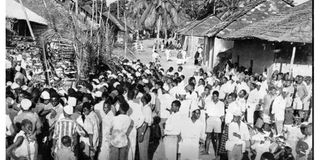
This is a tribute to the overlooked figures who quietly laid the foundations of uhuru.
Bibi Titi Mohammed: The woman who moved the masses Few figures translated nationalism into mass mobilisation as effectively as Bibi Titi Mohammed. When appointed to lead TANU’s women’s wing in 1955, she transformed it from a small committee into a nationwide movement. Her communication style relied not on political theory but on Swahili songs, metaphors and familiar expressions that resonated with market traders, domestic workers, village women and small business owners.
Under her leadership, women sold goats, pooled savings and recruited neighbours in their thousands. TANU gained legitimacy not only among elites but among the women who sustained households, markets and rural trade networks. Independence might still have come, but without Bibi Titi it would not have been embraced so broadly by ordinary families.
John Benedict Mwakangale: A regional voice with continental reach From the Southern Highlands emerged John Mwakangale, a politician whose influence bridged local organisation and continental solidarity. Through his work with the Pan-African Freedom Movement for East and Central Africa, he positioned Tanganyika’s struggle within the broader liberation currents of Kenya, Malawi, Uganda and other territories still under colonial rule.
At a moment when colonial authorities sought to isolate African movements and limit their cooperation, Mwakangale forged alliances and shared strategy. His efforts ensured Tanganyika’s independence was not an isolated event but part of a continental claim to black self-determination. His role extended far beyond Parliament—he linked remote villages to global liberation networks.
Michael Kamaliza and the workers’ front While nationalist politicians addressed rallies, some of the most decisive pressure on the colonial administration came from workers’ actions—strikes, boycotts and coordinated protests. At the centre of this mobilisation was Michael Kamaliza, who unified 17 unions under the Tanganyika Federation of Labour. Dockworkers, railway crews, clerks, tailors and plantation workers were organised into a single force capable of exerting national pressure.
Union halls became civic classrooms where workers discussed rights, dignity and the meaning of self-governance. Pamphlets circulated as coded political messages. By the late 1950s, nearly half of Tanganyika’s workforce was unionised. Kamaliza understood that workers sought more than wages: they wanted representation and a voice in shaping a post-colonial nation. Labour thus became the organised muscle of the independence movement.
Oscar Kambona: Party builder and diplomatic voice As TANU’s first Secretary-General and later Foreign Minister, Oscar Salathiel Kambona served both as the party’s chief organiser and its early diplomatic face. He coordinated branches across the country, trained district leaders and maintained internal cohesion at a time when the colonial state hoped to fracture the nationalist movement.
After independence, Kambona placed Tanganyika firmly within Pan-African and global liberation frameworks. From Accra to Lusaka, he reinforced the idea that Tanganyika was not an apprentice state but an equal partner in Africa’s freedom struggles. He gave the young nation organisational confidence and diplomatic clarity.
The grassroots machinery: Teachers, clergy, traders and youth Independence was not only shaped in parliamentary halls; it was whispered in markets, spread in church courtyards and debated in classrooms. Teachers photocopied pamphlets on school equipment, clergy linked freedom to moral dignity, and traders carried political leaflets across caravan routes. Youth groups, often disguised as community clubs, created early recruitment spaces.
These networks strengthened the earlier Tanzania African Association and later TANU as it expanded nationally. Market women circulated information faster than newspapers, while port workers created communication channels long before radio reached rural communities. Without these invisible mobilisers, nationalism might have remained an urban, elite project. With them, it became a truly national awakening.
Freedom’s quiet engineers The midnight of December 9, 1961, was the culmination of years of effort by women who sold livestock to fund TANU, dockworkers who halted ports to demand dignity, teachers who turned classrooms into meeting halls and organisers who connected local struggles to continental liberation.
As Tanzania shapes its future, it must remember that history belongs not only to those who sign documents, but to those who organise gatherings, circulate messages, sing liberation songs and insist—quietly but resolutely—that a people must govern itself.
Register to begin your journey to our premium contentSubscribe for full access to premium content