Urban planning sector faces integrity test amid skills gap
Director of Housing Development at the Ministry of Lands, Housing and Human Settlements Development, Deogratius Kalimenze (right), poses for a group photo with the Acting Registrar of the Town Planners Registration Board (TPRB), Martha Mkupasi, alongside TPRB officials in Dar es Salaam.
Tanzania has experienced significant urban growth over the decades, with nearly 50 percent of its population now living in urban areas, compared to just 5.7 percent in 1967—reflecting a major socio-economic transformation.
Dar es Salaam. Tanzania’s urban planning sector is grappling with a growing challenge as unqualified practitioners and firms increasingly take on key development projects, raising concerns over quality, professionalism and the long-term sustainability of cities.
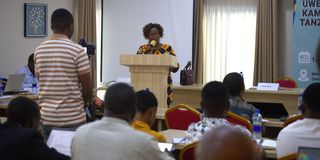
The revelation was made on Tuesday, April 14, 2026, by the Acting Registrar of the Town Planners Registration Board (TPRB), Ms Martha Mkupasi, during a capacity-building seminar for directors of urban planning firms in Dar es Salaam.
She warned that the trend is undermining both the credibility of the profession and the quality of projects being implemented across the country.
“Some projects are being executed by individuals or firms without the required qualifications, which compromises standards and damages the image of the profession,” she said.
According to Ms Mkupasi, weak operational systems within some firms have further reduced their competitiveness in the market, calling for strict adherence to professional standards and certification.
In response, the TPRB has rolled out specialised training programmes targeting leaders of urban planning firms. The initiative aims to enhance efficiency, improve competitiveness and enable local firms to secure major project tenders both locally and internationally.
She noted that the training will also help professionals expand their services beyond national borders and keep pace with evolving global standards in urban planning.
Speaking at the same event, the Director of Housing Development in the Ministry of Lands, Housing and Human Settlements Development, Mr Deogratius Kalimenze, emphasised the importance of continuous professional education in addressing rapid urbanisation.
He said the training provides a platform for professionals to exchange experiences and learn innovative approaches to managing urban growth.
Mr Kalimenze cautioned that unplanned urban expansion has already led to about 67.9 percent of settlements being established in unplanned areas, resulting in poor infrastructure, inadequate social services and encroachment on open spaces.
He also highlighted climate change as an emerging challenge that requires urban planners to adopt resilience-focused strategies to ensure sustainable development.
Tanzania has experienced significant urban growth over the decades, with nearly 50 percent of its population now living in urban areas, compared to just 5.7 percent in 1967—reflecting a major socio-economic transformation.
As cities continue to expand, stakeholders warn that strengthening professional standards and investing in continuous training will be critical to safeguarding the future of urban development in the country.