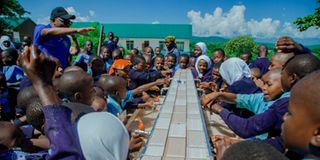
Iringa. Pupils at Jamhuri Primary School in Ilongo Village, Mbarali District in Mbeya Region have started benefiting from a safe and clean water project implemented by the Rufiji Basin Water Board (RBWB) through the Nature-Based Solutions for Sustainable Water Resources Management and Climate Change Resilience Project (NBS–USANGU), funded by the government of Japan through the World Bank.
Before the project, pupils were forced to walk more than three kilometres in search of water, a situation that affected attendance, increased fatigue and disrupted lessons, some arrived at school exhausted, and therefore, reduced their concentration in class.
Through the initiative, a deep borehole has been drilled and water supplied directly to the school and surrounding households, improving the learning environment and enhancing pupils’ safety.
Speaking during the recent project launch, the school’s head teacher, Ms Jenifer Sanga, described the availability of water within the school compound as a major transformation for pupils’ wellbeing.
“This is a great relief for us. Pupils will no longer waste time fetching water and will instead focus more on their studies. We believe academic performance will improve as the learning environment has been enhanced,” she said.
Ilongo Village chairperson, Mr Benjamin Mwakalonge, said the project has resolved a long-standing water shortage in the area.
“We are grateful for reaching our community. This water will not only benefit pupils but also residents living around the school. We now have access to water closer to our homes,” he said.
Cooperation between Japan and Tanzania continues to strengthen through development initiatives aimed at improving people’s livelihoods, particularly in rural areas facing water infrastructure challenges.
It has been noted that investment in the water sector is a crucial step towards improving health, education, and overall community wellbeing, with access to safe and clean water regarded as a foundation for sustainable development.
The project was implemented by the RBWB-under the NBS–USANGU), funded by the Government of Japan through the World Bank.
As a result, pupils at Jamhuri Primary School are now benefiting not only from improved access to water but also from better sanitation conditions, which are expected to reduce waterborne diseases linked to unsafe sources.
Some pupils, who spoke to The Citizen, expressed their excitement, noting that they now have sufficient time to study and participate fully in school activities.
“Availability of water will also support the establishment of school gardens and small nutrition projects, contributing to improved pupils’ health and boosting their motivation to learn,” said one of them declining to mention his name.
Overall, the project has emerged as a catalyst for positive change in Ilongo Village, demonstrating how sustainable water resource management can deliver direct benefits to education and wider community development.