Ex-Tamil Tigers find going tough after end of civil war
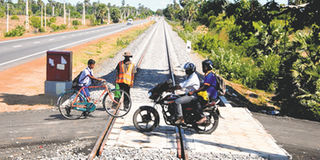
People near the northern village of Pallai in Sri Lanka cross a railway line that was under construction in September 2014. PHOTO |FILE
What you need to know:
Sivalingam Ruvendradass, who spent three years in a government “rehabilitation” programme, which is compulsory for former Tamil Tigers and provides them with education and vocational training, now looks back at wartime with some fondness.
Almost seven years after the end of Sri Lanka’s decades-long civil war, the majority of former Tamil Tiger rebels are struggling to find jobs despite billions of dollars of extra investment in their regions.
Sivalingam Ruvendradass, who spent three years in a government “rehabilitation” programme, which is compulsory for former Tamil Tigers and provides them with education and vocational training, now looks back at wartime with some fondness.
“Then at least I was getting something from the Tigers,” he told IRIN.
Despite his training in carpentry, steady work was impossible to find when Ruvendradass returned home to Vallipuram, a village near the Tigers’ former political and administrative centre of Kilinochchi.
“There are new highways, new railroads, new electricity and phone lines, but no jobs,” said the father-of-three, who makes a living by rearing chickens and doing odd jobs.
This wasn’t how it was supposed to be.
The previous government under Mahinda Rajapaksa poured $3.5 billion into Northern Province alone, most of it into large infrastructure projects like roads, railways and electricity, according to the Central Bank. The spending was meant to promote reconciliation through economic development in the war-torn region.
“It would show our resolve for co-existence,” said former president Rajapaksa in a 2011 speech inaugurating the construction of a new railway line to the north. “What we are attempting now is to breathe new life into the heart of the nation, to start the journey that would unite the entire nation.”
Analysts say the government programmes to develop the war zone have largely failed to stimulate the job market. That’s because most of the money has gone toward infrastructure projects, while neglecting employment generation initiatives such as tax breaks to encourage factories to move into the area, and moves to boost business development like low interest loans and training.
“I have always maintained that the focus needs to be on promoting private enterprises within the region – supporting small and medium entrepreneurs there (to) grow through finance, technology and market access,” said Anushka Wijesinha, chief economist at the Ceylon Chamber of Commerce.
Central Bank figures show that between 2010 and 2012, when the large construction projects were at a peak in the former war zone, only 5.8 per cent (24,303) of the 422,111 jobs created nationally were in Northern Province.
Muttukrishna Sarvananthan, who heads the Point Pedro Institute of Development, a research institute in the northern city of Jaffna, criticised the former government for employing mostly military personnel as labour in public projects. The strategy “deprived jobs for local people, especially youths,” he said.
There are around 12,000 former combatants, mostly in the Northern Province, who have been released after undergoing rehabilitation programmes, according to the Commissioner General of Rehabilitation. Only around 3,000 have gained permanent employment, most in the civil defence force under the police department.
Two of the worst hit districts during the conflict, Mullaitivu and Kilinochchi in the Northern Province, have been plagued by high unemployment since the fighting ended in 2009. Kilinochchi suffers from the highest national unemployment rate at 7.6 per cent, compared to the national average of 4.3 per cent, according to national the Department of Census and Statistics.
Officially, the unemployment rate is 5.3 per cent in Northern Province and 4.9 per cent in Eastern Province, another former Tamil Tiger heartland that is struggling to recover from the war. True unemployment rates in both provinces are likely far higher.
The writer filed this article from Vallipuram, Sri Lanka